
At 650 K, the reaction MgCO3(s) ⇌ MgO(s) + CO2(g) has Kp = 0.026. A 10.0-L container at 650 K has 1.0 g of MgO(s) and CO2 at P = 0.0260 atm. The container is then compressed to a volume of 0.100 L. Find the mass of MgCO3 that is formed.
Ch.15 - Chemical Equilibrium
15장, 문제 79
Consider the exothermic reaction: C2H4(g) + Cl2(g) ⇌ C2H4Cl2(g) If you were trying to maximize the amount of C2H4Cl2 produced, which tactic might you try? Assume that the reaction mixture reaches equilibrium. a. increasing the reaction volume b. removing C2H4Cl2 from the reaction mixture as it forms c. lowering the reaction temperature d. adding Cl2
검증된 단계별 안내1
Identify the nature of the reaction: The given reaction is exothermic, meaning it releases heat. Therefore, changes in temperature can affect the equilibrium position.
Apply Le Chatelier's Principle: This principle states that if a dynamic equilibrium is disturbed by changing the conditions, the position of equilibrium moves to counteract the change. In the context of an exothermic reaction, lowering the temperature shifts the equilibrium towards the products.
Consider the effect of lowering the temperature: Since the reaction is exothermic, reducing the temperature favors the formation of more products (C2H4Cl2) because the system seeks to produce more heat to counterbalance the temperature decrease.
Evaluate other options: Increasing the reaction volume generally shifts the equilibrium towards the side with more moles of gas. In this case, the number of moles of reactants and products are the same, so this change would not be effective. Removing C2H4Cl2 as it forms would indeed shift the equilibrium towards more product formation to replace what is removed. Adding more Cl2 would also shift the equilibrium towards more product formation by increasing the concentration of one of the reactants.
Choose the best tactic: Based on Le Chatelier's Principle and the nature of the reaction, lowering the reaction temperature (option c) is a strategic way to maximize the production of C2H4Cl2 in an exothermic reaction.

비슷한 문제에 대한 검증된 영상 답변:
이 영상 해법은 위 문제에 도움이 된다고 튜터들이 추천한 것입니다.
주요 개념
질문에 올바르게 답하기 위해 반드시 이해해야 하는 핵심 개념들은 다음과 같습니다.
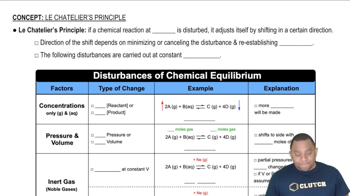
Le Chatelier's Principle
Le Chatelier's Principle states that if a dynamic equilibrium is disturbed by changing the conditions, the position of equilibrium shifts to counteract the change. This principle helps predict how a system at equilibrium will respond to changes in concentration, temperature, or pressure, allowing for strategies to maximize product formation.
추천 영상:
가이드 코스
Le Chatelier's Principle
Exothermic Reactions
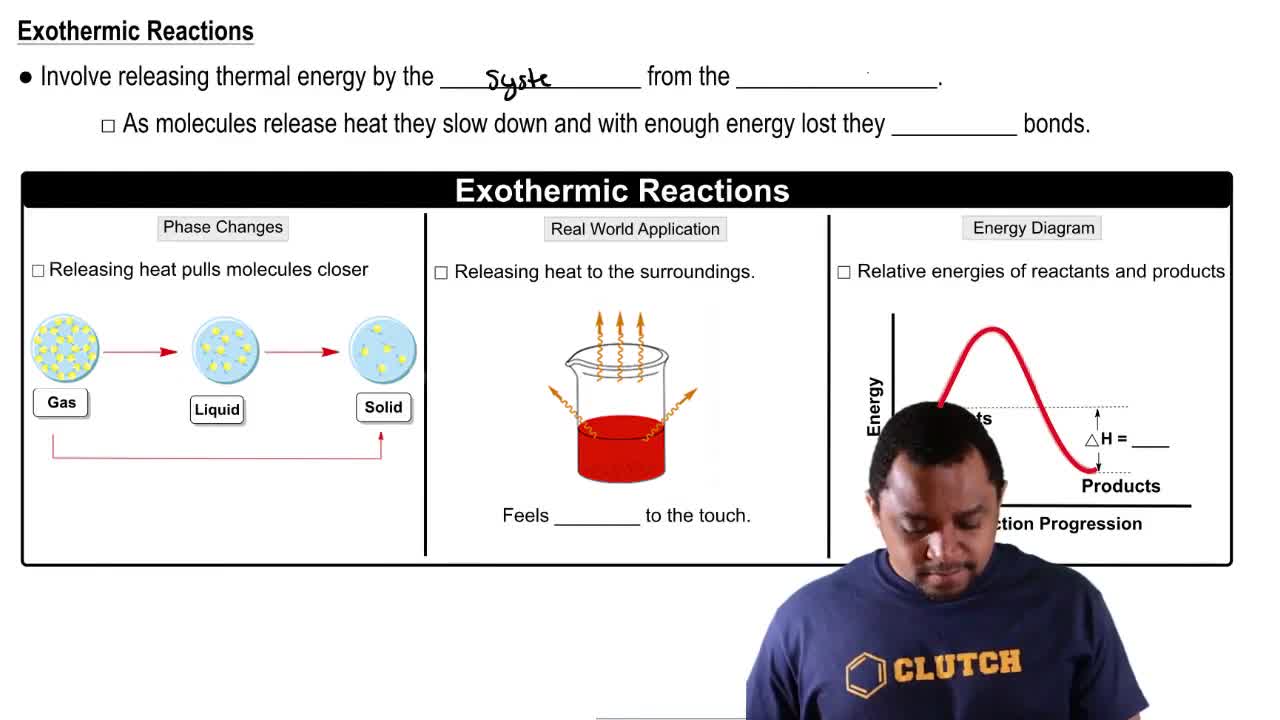
Exothermic reactions release heat as they proceed, resulting in a decrease in the system's internal energy. For exothermic reactions, lowering the temperature generally favors the formation of products, as the system shifts to produce more heat to counteract the temperature change, thus increasing the yield of products like C2H4Cl2.
추천 영상:
가이드 코스
Endothermic & Exothermic Reactions
Equilibrium Constant (K)
The equilibrium constant (K) quantifies the ratio of the concentrations of products to reactants at equilibrium for a given reaction at a specific temperature. Changes in concentration or pressure can shift the equilibrium position, affecting the amounts of reactants and products present, which is crucial for determining the best tactic to maximize C2H4Cl2 production.
추천 영상:
가이드 코스
Equilibrium Constant K
관련 실천
교과서 질문
2253
views
교과서 질문
Consider the endothermic reaction: C2H4(g) + I2(g) ⇌ C2H4I2(g) If you were trying to maximize the amount of C2H4I2 produced, which tactic might you try? Assume that the reaction mixture reaches equilibrium. a. decreasing the reaction volume b. removing I2 from the reaction mixture c. raising the reaction temperature d. adding C2H4 to the reaction mixture
1517
views
교과서 질문
Consider the reaction: H2(g) + I2(g) ⇌ 2 HI(g) A reaction mixture at equilibrium at 175 K contains PH2 = 0.958 atm, PI2 = 0.877 atm, and PHI = 0.020 atm. A second reaction mixture, also at 175 K, contains PH2 = PI2 = 0.621 atm and PHI = 0.101 atm. Is the second reaction at equilibrium? If not, what will be the partial pressure of HI when the reaction reaches equilibrium at 175 K?
2877
views
