
Ch.15 - Chemical Equilibrium
Tro - Chemistry: A Molecular Approach 4th Edition
Tro4th EditionChemistry: A Molecular ApproachISBN: 9780134112831당신이 사용하는 게 아니라요?교과서 변경
15장, 문제 28c

This reaction has an equilibrium constant of Kp = 2.2⨉106 at 298 K. 2 COF2(g) ⇌ CO2(g) + CF4(g) Calculate Kp for each reaction and predict whether reactants or products will be favored at equilibrium.
c. 2 CO2(g) + 2 CF4(g) ⇌ 4 COF2(g)

검증된 단계별 안내
1
Identify the relationship between the given reaction and the reaction in part c. The reaction in part c is the reverse of the given reaction and also doubled.
Recall that the equilibrium constant for the reverse reaction is the inverse of the equilibrium constant for the forward reaction. Therefore, calculate the inverse of Kp for the given reaction.
Since the reaction in part c is also doubled, raise the inverse of Kp to the power of 2 to account for the stoichiometry change.
Compare the magnitude of the new Kp value to 1. If Kp is greater than 1, the products are favored at equilibrium; if Kp is less than 1, the reactants are favored.
Predict whether reactants or products will be favored at equilibrium based on the calculated Kp value for the reaction in part c.

비슷한 문제에 대한 검증된 영상 답변:

이 영상 해법은 위 문제에 도움이 된다고 튜터들이 추천한 것입니다.
영상 길이:
1m

주요 개념

질문에 올바르게 답하기 위해 반드시 이해해야 하는 핵심 개념들은 다음과 같습니다.

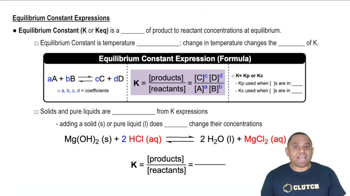
Equilibrium Constant (Kp)

The equilibrium constant (Kp) is a numerical value that expresses the ratio of the concentrations of products to reactants at equilibrium for a given reaction at a specific temperature. It is calculated using the partial pressures of gases involved in the reaction. A large Kp value (greater than 1) indicates that products are favored at equilibrium, while a small Kp value (less than 1) suggests that reactants are favored.
추천 영상:
가이드 코스
03:20
Equilibrium Constant Expressions

Reaction Quotient (Q)

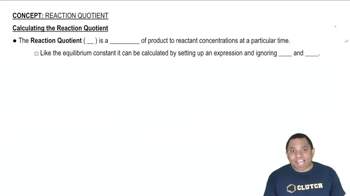
The reaction quotient (Q) is a measure of the relative amounts of products and reactants at any point in a reaction, not just at equilibrium. It is calculated in the same way as Kp but uses the current concentrations or partial pressures. By comparing Q to Kp, one can predict the direction in which the reaction will proceed to reach equilibrium: if Q < Kp, the reaction will shift to the right (toward products), and if Q > Kp, it will shift to the left (toward reactants).
추천 영상:
가이드 코스
00:49
Reaction Quotient Q

Le Chatelier's Principle

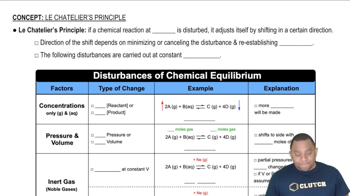
Le Chatelier's Principle states that if a dynamic equilibrium is disturbed by changing the conditions (such as concentration, pressure, or temperature), the system will adjust to counteract the change and restore a new equilibrium. This principle helps predict how a change in concentration of reactants or products will affect the position of equilibrium, guiding the understanding of whether reactants or products will be favored in a given reaction.
추천 영상:
가이드 코스
07:32
Le Chatelier's Principle