Ch.16 - Acids and Bases
Tro - Chemistry: A Molecular Approach 4th Edition
Tro4th EditionChemistry: A Molecular ApproachISBN: 9780134112831당신이 사용하는 게 아니라요?교과서 변경
16장, 문제 115

Calculate the [H3O+] and pH of each H2SO4 solution. At approximately what concentration does the x is small approximation break down?
a. 0.50 M b. 0.10 M c. 0.050 M

검증된 단계별 안내
1
Start by recognizing that \(\text{H}_2\text{SO}_4\) is a strong acid that dissociates completely in water to form \(\text{H}_3\text{O}^+\) and \(\text{HSO}_4^-\). The first dissociation is complete: \(\text{H}_2\text{SO}_4 \rightarrow \text{H}^+ + \text{HSO}_4^-\).
For each concentration given, calculate the initial concentration of \(\text{H}_3\text{O}^+\) from the complete dissociation of \(\text{H}_2\text{SO}_4\). For example, for 0.50 M \(\text{H}_2\text{SO}_4\), the initial \([\text{H}_3\text{O}^+]\) is 0.50 M.
Consider the second dissociation of \(\text{HSO}_4^-\), which is a weak acid: \(\text{HSO}_4^- \rightleftharpoons \text{H}^+ + \text{SO}_4^{2-}\). Use the equilibrium expression \(K_a = \frac{[\text{H}^+][\text{SO}_4^{2-}]}{[\text{HSO}_4^-]}\) to find the additional \([\text{H}_3\text{O}^+]\) contributed by this step.
Use the 'x is small' approximation to simplify the equilibrium expression for the second dissociation. Assume that the change in concentration of \(\text{H}_3\text{O}^+\) due to the second dissociation is small compared to the initial concentration from the first dissociation.
Calculate the pH using the formula \(\text{pH} = -\log[\text{H}_3\text{O}^+]\). Determine at what concentration the 'x is small' approximation breaks down by checking when the change in \([\text{H}_3\text{O}^+]\) from the second dissociation is not negligible compared to the initial concentration.>

비슷한 문제에 대한 검증된 영상 답변:

이 영상 해법은 위 문제에 도움이 된다고 튜터들이 추천한 것입니다.
영상 길이:
11m
도움이 되었나요?

주요 개념

질문에 올바르게 답하기 위해 반드시 이해해야 하는 핵심 개념들은 다음과 같습니다.

Strong Acids and Ionization

Strong acids, like sulfuric acid (H2SO4), completely dissociate in water, meaning that all the acid molecules break apart into ions. For H2SO4, the first dissociation step produces H3O+ and HSO4-, leading to a direct relationship between the concentration of the acid and the concentration of H3O+. Understanding this complete ionization is crucial for calculating pH.
추천 영상:
가이드 코스
01:09
Strong Acid-Strong Base Titration

pH Calculation

pH is a measure of the acidity of a solution, defined as the negative logarithm of the hydronium ion concentration: pH = -log[H3O+]. For strong acids, the pH can be directly calculated from the concentration of the acid, as the concentration of H3O+ will equal the concentration of the acid due to complete dissociation. This relationship simplifies the calculation of pH for strong acids.
추천 영상:
가이드 코스
02:15
pH Calculation Example

x is Small Approximation

The 'x is small' approximation is used in equilibrium calculations when the change in concentration (x) is negligible compared to the initial concentration. This approximation is valid when the initial concentration of the acid is significantly higher than the amount that dissociates. For strong acids like H2SO4, this approximation breaks down at higher concentrations, typically when the concentration approaches 0.1 M or higher, where the assumption of negligible change becomes invalid.
추천 영상:
가이드 코스
04:23
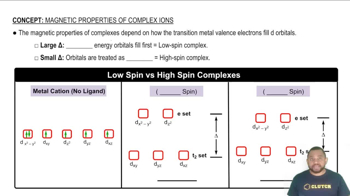
Low-Spin Complexes are associated with large Δ values and High-Spin Complexes are associated with small Δ values.