Caffeine (C8H10N4O2) is a weak base with a pKb of 10.4. Calculate the pH of a solution containing a caffeine concentration of 455 mg/L.
Ch.16 - Acids and Bases
16장, 문제 89
Determine the [OH–], pH, and pOH of a 0.15 M ammonia solution.
검증된 단계별 안내1
1. Ammonia is a weak base, so it will react with water to form ammonium ions and hydroxide ions. The reaction is: NH3(aq) + H2O(l) ⇌ NH4+(aq) + OH-(aq).
2. To find the concentration of OH-, we need to use the Kb expression for ammonia. Kb is the base ionization constant, which is a measure of how much a base ionizes in solution. The Kb expression for ammonia is: Kb = [NH4+][OH-] / [NH3]. You can look up the Kb value for ammonia in a table, it is typically around 1.8 x 10^-5.
3. Since we are dealing with a weak base, we can make the assumption that the change in concentration of NH3 is approximately equal to the concentration of OH- produced. Therefore, we can set up the Kb expression as follows: Kb = x^2 / (0.15 - x), where x is the concentration of OH-.
4. Solve the above equation for x, which will give you the concentration of OH-. This involves some algebra and possibly the use of the quadratic formula. Remember that x is approximately equal to the concentration of OH-, so the concentration of OH- is approximately equal to the square root of (Kb * initial concentration of NH3).
5. Once you have the concentration of OH-, you can find the pOH by taking the negative logarithm (base 10) of the OH- concentration. The pH can then be found by subtracting the pOH from 14, since pH + pOH = 14 at 25 degrees Celsius.

비슷한 문제에 대한 검증된 영상 답변:
이 영상 해법은 위 문제에 도움이 된다고 튜터들이 추천한 것입니다.
영상 길이:
4m도움이 되었나요?
주요 개념
질문에 올바르게 답하기 위해 반드시 이해해야 하는 핵심 개념들은 다음과 같습니다.
Ammonia as a Weak Base
Ammonia (NH3) is a weak base that partially ionizes in water to form hydroxide ions (OH-) and ammonium ions (NH4+). The equilibrium reaction can be represented as NH3 + H2O ⇌ NH4+ + OH-. Understanding this equilibrium is crucial for calculating the concentration of hydroxide ions in the solution.
추천 영상:
가이드 코스
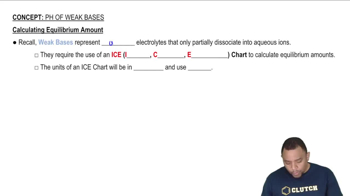
ICE Charts of Weak Bases
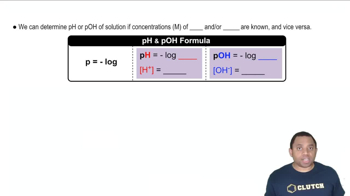
pH, pOH, and Their Relationship
pH and pOH are measures of the acidity and basicity of a solution, respectively. They are related by the equation pH + pOH = 14 at 25°C. The pH is calculated from the concentration of hydrogen ions (H+), while pOH is derived from the concentration of hydroxide ions (OH-). This relationship is essential for determining the pH and pOH of the ammonia solution.
추천 영상:
가이드 코스
pH and pOH Calculations
Equilibrium Constant (Kb) for Ammonia
The base dissociation constant (Kb) quantifies the strength of a weak base like ammonia in water. For ammonia, Kb is approximately 1.8 x 10^-5. This constant is used in the equilibrium expression to calculate the concentration of OH- ions in the solution, which is necessary for finding the pH and pOH values.
추천 영상:
가이드 코스
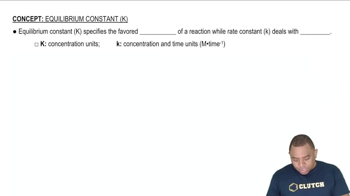
Equilibrium Constant K
관련 실천
교과서 질문
3290
views
4
rank
교과서 질문
Write equations showing how each weak base ionizes water to form OH–. Also write the corresponding expression for Kb. b. C6H5NH2
358
views
교과서 질문
Morphine is a weak base. A 0.150 M solution of morphine has a pH of 10.7. What is Kb for morphine?
3278
views
1
comments
교과서 질문
Write equations showing how each weak base ionizes water to form OH–. Also write the corresponding expression for Kb. c. C2H5NH2
905
views
교과서 질문
Write equations showing how each weak base ionizes water to form OH–. Also write the corresponding expression for Kb. a. CO32–
951
views
교과서 질문
Amphetamine (C9H13N) is a weak base with a pKb of 4.2. Calculate the pH of a solution containing an amphetamine concentration of 225 mg/L.
2435
views