Ch.16 - Acids and Bases
Tro - Chemistry: A Molecular Approach 4th Edition
Tro4th EditionChemistry: A Molecular ApproachISBN: 9780134112831당신이 사용하는 게 아니라요?교과서 변경
16장, 문제 84

Determine the pH of a solution that is 1.55% NaOH by mass. Assume that the solution has a density of 1.01 g/mL.

검증된 단계별 안내
1
Calculate the mass of NaOH in 100 g of solution: Since the solution is 1.55% NaOH by mass, there are 1.55 g of NaOH in 100 g of solution.
Determine the volume of the solution: Use the density to find the volume. Since the density is 1.01 g/mL, the volume of 100 g of solution is 100 g / 1.01 g/mL.
Calculate the molarity of the NaOH solution: First, find the number of moles of NaOH using its molar mass (approximately 40.00 g/mol). Then, divide the moles of NaOH by the volume of the solution in liters to find the molarity.
Determine the concentration of OH⁻ ions: Since NaOH is a strong base, it dissociates completely in water. Therefore, the concentration of OH⁻ ions is equal to the molarity of the NaOH solution.
Calculate the pH of the solution: Use the concentration of OH⁻ ions to find the pOH of the solution. Then, use the relationship pH + pOH = 14 to find the pH.

주요 개념

질문에 올바르게 답하기 위해 반드시 이해해야 하는 핵심 개념들은 다음과 같습니다.

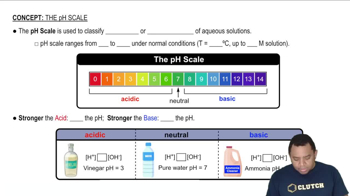
pH Scale

The pH scale measures the acidity or basicity of a solution, ranging from 0 to 14. A pH of 7 is neutral, values below 7 indicate acidity, and values above 7 indicate basicity. The pH is calculated as the negative logarithm of the hydrogen ion concentration in the solution, with lower pH values corresponding to higher concentrations of hydrogen ions.
추천 영상:

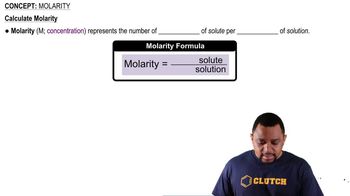
Concentration and Molarity

Concentration refers to the amount of solute present in a given volume of solution. Molarity, a common unit of concentration, is defined as moles of solute per liter of solution. To determine the pH of a NaOH solution, one must first convert the mass percentage to molarity, which involves calculating the number of moles of NaOH in a specific volume of the solution.
추천 영상:
가이드 코스
00:53
Molarity Concept

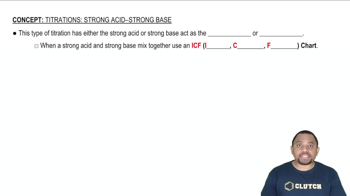
Dissociation of Strong Bases

Strong bases, like sodium hydroxide (NaOH), completely dissociate in water to produce hydroxide ions (OH⁻). This complete dissociation means that the concentration of hydroxide ions in the solution is equal to the molarity of the NaOH. The pOH can be calculated from the hydroxide ion concentration, and the pH can then be derived using the relationship pH + pOH = 14.
추천 영상:
가이드 코스
01:09
Strong Acid-Strong Base Titration