Ch.16 - Acids and Bases
Tro - Chemistry: A Molecular Approach 4th Edition
Tro4th EditionChemistry: A Molecular ApproachISBN: 9780134112831당신이 사용하는 게 아니라요?교과서 변경
16장, 문제 105a

Determine the pH of each solution. a. 0.10 M NH4Cl

검증된 단계별 안내
1
Step 1: Identify that NH4Cl is a salt and will dissociate completely in water to form NH4+ and Cl-. The NH4+ ion is the conjugate acid of the weak base NH3, and will therefore react with water to form NH3 and H3O+.
Step 2: Write the chemical equation for the reaction of NH4+ with water: NH4+ + H2O -> NH3 + H3O+.
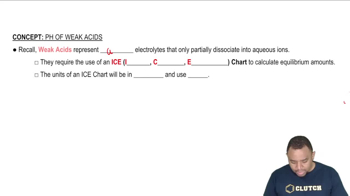
Step 3: Set up an ICE (Initial, Change, Equilibrium) table to keep track of the concentrations of each species. Initially, the concentration of NH4+ is 0.10 M, and the concentrations of NH3 and H3O+ are 0. At equilibrium, the concentration of NH4+ will have decreased by x, and the concentrations of NH3 and H3O+ will have increased by x.
Step 4: Write the expression for the equilibrium constant of the reaction, Ka, which is equal to [NH3][H3O+] / [NH4+]. Since NH4+ is the conjugate acid of NH3, Ka can be found by taking the inverse of the Kb for NH3 and using the relationship Kw = Ka * Kb.
Step 5: Substitute the equilibrium concentrations from the ICE table into the Ka expression and solve for x, which represents the concentration of H3O+ at equilibrium. The pH of the solution can then be found by taking the negative logarithm of the H3O+ concentration.

비슷한 문제에 대한 검증된 영상 답변:

이 영상 해법은 위 문제에 도움이 된다고 튜터들이 추천한 것입니다.
영상 길이:
9m
도움이 되었나요?

주요 개념

질문에 올바르게 답하기 위해 반드시 이해해야 하는 핵심 개념들은 다음과 같습니다.

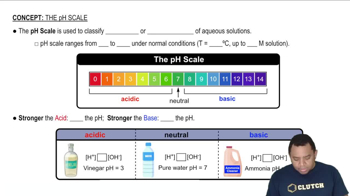
pH Scale

The pH scale measures the acidity or basicity of a solution, ranging from 0 to 14. A pH of 7 is considered neutral, while values below 7 indicate acidity and values above 7 indicate basicity. The scale is logarithmic, meaning each whole number change represents a tenfold change in hydrogen ion concentration.
추천 영상:

Ammonium Chloride (NH4Cl) as a Weak Acid

Ammonium chloride is a salt formed from the weak base ammonia (NH3) and the strong acid hydrochloric acid (HCl). In solution, NH4Cl dissociates into NH4+ and Cl-. The NH4+ ion can donate a proton to water, forming NH3 and H3O+, which contributes to the acidity of the solution, thus lowering the pH.
추천 영상:
가이드 코스
00:44
ICE Charts of Weak Acids

Henderson-Hasselbalch Equation

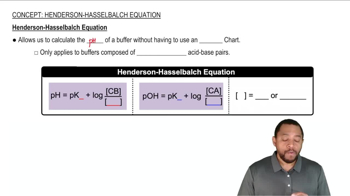
The Henderson-Hasselbalch equation relates the pH of a solution to the concentration of an acid and its conjugate base. For weak acids, it is expressed as pH = pKa + log([A-]/[HA]). This equation is useful for calculating the pH of buffer solutions and can be adapted to find the pH of solutions containing weak acids or their salts, like NH4Cl.
추천 영상:
가이드 코스
02:40
Henderson-Hasselbalch Equation