

Ch.16 - Acids and Bases
Tro - Chemistry: A Molecular Approach 4th Edition
Tro4th EditionChemistry: A Molecular ApproachISBN: 9780134112831당신이 사용하는 게 아니라요?교과서 변경
16장, 문제 140d

Determine the pH of each two-component solution. d. 0.088 M HClO4 and 0.022 M KOH

검증된 단계별 안내
1
Identify the nature of the substances: HClO4 is a strong acid and KOH is a strong base.
Write the balanced chemical equation for the reaction: \( \text{HClO}_4 + \text{KOH} \rightarrow \text{KClO}_4 + \text{H}_2\text{O} \).
Calculate the moles of HClO4 and KOH using their concentrations and the volume of the solution (assuming 1 L for simplicity).
Determine the limiting reactant by comparing the moles of HClO4 and KOH.
Calculate the concentration of excess HClO4 or KOH after the reaction, and use it to find the pH or pOH, then convert to pH if necessary.

비슷한 문제에 대한 검증된 영상 답변:

이 영상 해법은 위 문제에 도움이 된다고 튜터들이 추천한 것입니다.
영상 길이:
4m
도움이 되었나요?

주요 개념

질문에 올바르게 답하기 위해 반드시 이해해야 하는 핵심 개념들은 다음과 같습니다.

pH Scale

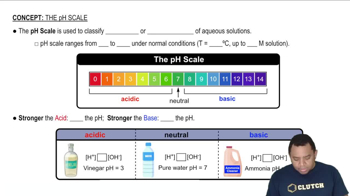
The pH scale measures the acidity or basicity of a solution, ranging from 0 to 14. A pH of 7 is neutral, below 7 indicates acidity, and above 7 indicates basicity. The scale is logarithmic, meaning each whole number change represents a tenfold change in hydrogen ion concentration. Understanding pH is crucial for analyzing the behavior of acids and bases in solution.
추천 영상:

Strong Acids and Bases

Strong acids, like HClO4, completely dissociate in water, releasing all their hydrogen ions (H+), while strong bases, like KOH, fully dissociate to release hydroxide ions (OH-). This complete dissociation simplifies calculations of pH, as the concentration of the acid or base directly determines the concentration of H+ or OH- ions in the solution. Recognizing the strength of acids and bases is essential for accurate pH determination.
추천 영상:
가이드 코스
01:09
Strong Acid-Strong Base Titration

Neutralization Reaction

A neutralization reaction occurs when an acid reacts with a base to form water and a salt, typically resulting in a solution that is closer to neutral pH. In this case, the H+ ions from HClO4 will react with the OH- ions from KOH. The extent of this reaction influences the final pH of the solution, making it important to consider the stoichiometry of the reactants involved.
추천 영상:
가이드 코스
05:56
Lewis Dot Structures: Neutral Compounds