Ch.17 - Aqueous Ionic Equilibrium
Tro - Chemistry: A Molecular Approach 4th Edition
Tro4th EditionChemistry: A Molecular ApproachISBN: 9780134112831당신이 사용하는 게 아니라요?교과서 변경
17장, 문제 52

A 100.0-mL buffer solution is 0.100 M in NH3 and 0.125 M in NH4Br. What mass of HCl can this buffer neutralize before the pH falls below 9.00?

검증된 단계별 안내
1
First, we need to calculate the pOH from the given pH. We can use the formula pOH = 14 - pH.
Next, we need to calculate the concentration of OH- ions using the formula [OH-] = 10^-pOH.
Then, we need to calculate the concentration of NH3 in the buffer solution. We know that the concentration of NH3 is 0.100 M.
Now, we need to calculate the concentration of NH4+ ions in the buffer solution. We know that the concentration of NH4+ is 0.125 M.
Finally, we can calculate the mass of HCl that the buffer can neutralize. We know that the reaction between NH3 and HCl produces NH4+ and Cl-. Therefore, the amount of HCl that can be neutralized is equal to the amount of NH3 present in the buffer. We can use the formula mass = volume x concentration x molar mass to calculate the mass of HCl.

비슷한 문제에 대한 검증된 영상 답변:

이 영상 해법은 위 문제에 도움이 된다고 튜터들이 추천한 것입니다.
영상 길이:
5m
도움이 되었나요?

주요 개념

질문에 올바르게 답하기 위해 반드시 이해해야 하는 핵심 개념들은 다음과 같습니다.

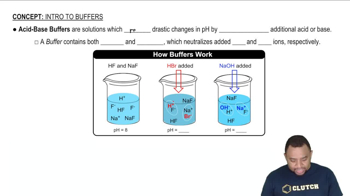
Buffer Solutions

Buffer solutions are mixtures that resist changes in pH when small amounts of acid or base are added. They typically consist of a weak acid and its conjugate base or a weak base and its conjugate acid. In this case, the NH3/NH4Br system acts as a buffer, maintaining the pH around 9.00 despite the addition of HCl.
추천 영상:
가이드 코스
03:02
Buffer Solutions

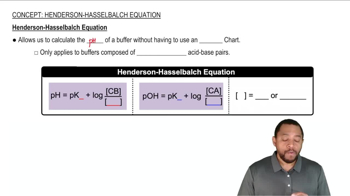
Henderson-Hasselbalch Equation

The Henderson-Hasselbalch equation relates the pH of a buffer solution to the concentration of its acidic and basic components. It is expressed as pH = pKa + log([A-]/[HA]). For the NH3/NH4+ buffer, knowing the pKa allows us to calculate how much HCl can be added before the pH drops below a specified value.
추천 영상:
가이드 코스
02:40
Henderson-Hasselbalch Equation

Neutralization Reaction

A neutralization reaction occurs when an acid reacts with a base to form water and a salt. In this scenario, HCl (strong acid) will react with NH3 (weak base) to form NH4Cl and water. The extent of this reaction determines how much HCl can be added to the buffer before the pH changes significantly.
추천 영상:
가이드 코스
05:56
Lewis Dot Structures: Neutral Compounds