Ch.17 - Aqueous Ionic Equilibrium
Tro - Chemistry: A Molecular Approach 4th Edition
Tro4th EditionChemistry: A Molecular ApproachISBN: 9780134112831당신이 사용하는 게 아니라요?교과서 변경
17장, 문제 55c

Blood is buffered by carbonic acid and the bicarbonate ion. Normal blood plasma is 0.024 M in HCO3- and 0.0012 M H2CO3 (pKa1 for H2CO3 at body temperature is 6.1).
c. Given the volume from part (b), what mass of NaOH can be neutralized before the pH rises above 7.8?

검증된 단계별 안내
1
1. The first step is to understand the concept of buffers. A buffer is a solution that can resist pH change upon the addition of an acidic or basic components. It is able to neutralize small amounts of added acid or base, thus maintaining the pH of the solution relatively stable. This is achieved by including a weak acid and its conjugate base (as in this case, H2CO3 and HCO3-).
2. The Henderson-Hasselbalch equation is used to calculate the pH of a buffer solution. The equation is: pH = pKa + log([A-]/[HA]), where [A-] is the molar concentration of the base (HCO3- in this case) and [HA] is the molar concentration of the acid (H2CO3 in this case).
3. To find the pH at which NaOH can be neutralized, we need to rearrange the Henderson-Hasselbalch equation to solve for [A-]/[HA]. This gives us: [A-]/[HA] = 10^(pH - pKa). We can then substitute the given pH (7.8) and pKa (6.1) into this equation to find the ratio of [A-] to [HA] at this pH.
4. Once we have the ratio of [A-] to [HA], we can use it to calculate the amount of NaOH that can be neutralized. This is because the addition of NaOH will consume H2CO3 and produce HCO3-, changing the ratio of [A-] to [HA]. We can set up an equation representing this reaction and solve for the amount of NaOH that can be added before the ratio of [A-] to [HA] reaches the value calculated in step 3.
5. Finally, once we have the amount of NaOH in moles, we can convert it to mass by multiplying by the molar mass of NaOH (approximately 40 g/mol). This will give us the mass of NaOH that can be neutralized before the pH rises above 7.8.

비슷한 문제에 대한 검증된 영상 답변:

이 영상 해법은 위 문제에 도움이 된다고 튜터들이 추천한 것입니다.
영상 길이:
4m
도움이 되었나요?

주요 개념

질문에 올바르게 답하기 위해 반드시 이해해야 하는 핵심 개념들은 다음과 같습니다.

Buffer Systems

Buffer systems are solutions that resist changes in pH upon the addition of small amounts of acids or bases. In blood, the carbonic acid (H2CO3) and bicarbonate ion (HCO3-) work together to maintain a stable pH, crucial for physiological functions. The equilibrium between these two components allows the blood to neutralize excess acids or bases, keeping the pH within a narrow range.
추천 영상:
가이드 코스
00:45
Buffer Capacity

pKa and Acid-Base Equilibrium

The pKa value is a measure of the strength of an acid in solution, indicating the pH at which half of the acid is dissociated. For carbonic acid, with a pKa of 6.1, this means that at pH 6.1, the concentrations of H2CO3 and HCO3- are equal. Understanding pKa is essential for predicting how the buffer system will respond to added acids or bases, such as NaOH in this case.
추천 영상:
가이드 코스
04:30
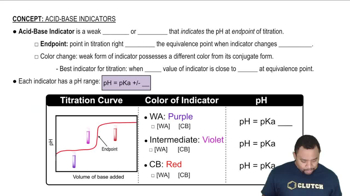
Acid-Base Indicators

Neutralization Reactions

Neutralization reactions occur when an acid reacts with a base to form water and a salt, effectively reducing the acidity or basicity of the solution. In this scenario, adding NaOH (a strong base) to the buffered solution will react with H2CO3, leading to the formation of HCO3- and water. Calculating the mass of NaOH that can be added before the pH exceeds 7.8 involves understanding the stoichiometry of the reaction and the buffer capacity.
추천 영상:
가이드 코스
05:56
Lewis Dot Structures: Neutral Compounds