Ch.17 - Aqueous Ionic Equilibrium
Tro - Chemistry: A Molecular Approach 4th Edition
Tro4th EditionChemistry: A Molecular ApproachISBN: 9780134112831당신이 사용하는 게 아니라요?교과서 변경
17장, 문제 32

What is the percent ionization of a 0.13 M formic acid solution in pure water, and how does it compare to the percent ionization in a solution containing 0.11 M potassium formate?

검증된 단계별 안내
1
Identify the chemical equation for the ionization of formic acid: \(\text{HCOOH} \rightleftharpoons \text{H}^+ + \text{HCOO}^-\). Formic acid is a weak acid, so it partially ionizes in solution.
Use the expression for the acid dissociation constant (\(K_a\)) for formic acid: \(K_a = \frac{[\text{H}^+][\text{HCOO}^-]}{[\text{HCOOH}]}\). Look up or be given the \(K_a\) value for formic acid.
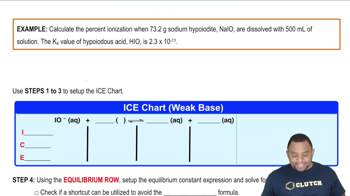
For the 0.13 M formic acid solution, set up an ICE (Initial, Change, Equilibrium) table to determine the concentrations of ions at equilibrium. Assume initial concentrations: \([\text{HCOOH}] = 0.13\) M, \([\text{H}^+] = 0\), \([\text{HCOO}^-] = 0\).
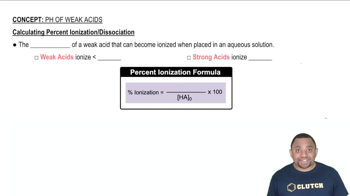
Calculate the percent ionization for the 0.13 M formic acid solution using the formula: \(\text{Percent Ionization} = \left(\frac{[\text{H}^+]}{[\text{HCOOH}]_{\text{initial}}}\right) \times 100\%\). Use the equilibrium concentration of \([\text{H}^+]\) from the ICE table.
For the solution containing 0.11 M potassium formate, recognize that potassium formate is a salt that provides the common ion \(\text{HCOO}^-\). Apply the common ion effect to the equilibrium, which will suppress the ionization of formic acid, and recalculate the percent ionization using a modified ICE table.

주요 개념

질문에 올바르게 답하기 위해 반드시 이해해야 하는 핵심 개념들은 다음과 같습니다.

Ionization of Weak Acids

Ionization refers to the process by which a weak acid, such as formic acid, partially dissociates in solution to produce hydrogen ions (H+) and its conjugate base. The extent of ionization is influenced by the acid's dissociation constant (Ka) and the concentration of the acid. In dilute solutions, weak acids exhibit low ionization, which can be quantitatively expressed as a percentage of the initial concentration.
추천 영상:
가이드 코스
01:15
Calculating Percent Ionization of Weak Acids

Percent Ionization

Percent ionization is a measure of the degree to which an acid dissociates in solution, calculated as the ratio of the concentration of ionized acid to the initial concentration, multiplied by 100. It provides insight into the strength of the acid and how it behaves in different concentrations. For weak acids, percent ionization typically increases as the concentration decreases, due to the shift in equilibrium.
추천 영상:
가이드 코스
06:08
Percent Ionization Example

Common Ion Effect

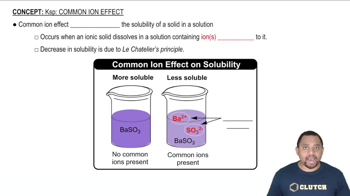
The common ion effect describes the decrease in the solubility of a salt or the ionization of a weak acid when a common ion is added to the solution. In the case of formic acid and potassium formate, the presence of the formate ion from potassium formate suppresses the ionization of formic acid, leading to a lower percent ionization compared to a solution without the common ion.
추천 영상:
가이드 코스
02:53
Common Ion Effect