
Ch.17 - Aqueous Ionic Equilibrium
Tro - Chemistry: A Molecular Approach 4th Edition
Tro4th EditionChemistry: A Molecular ApproachISBN: 9780134112831당신이 사용하는 게 아니라요?교과서 변경
17장, 문제 124

Calculate the pH at the beginning of the titration, at the equivalence point, at one-half of the equivalence point, and at 5.0 mL beyond the equivalence point to sketch the titration curve from Problem 123. Then, choose a suitable indicator for this titration from Table 17.1.

검증된 단계별 안내
1
insert step 1: Identify the type of titration involved, such as strong acid-strong base, weak acid-strong base, or weak base-strong acid. This will help determine the pH calculations at different points.
insert step 2: Calculate the initial pH before any titrant is added. For a weak acid or base, use the initial concentration and the appropriate equilibrium expression to find the pH.
insert step 3: Determine the pH at the equivalence point. For a strong acid-strong base titration, the pH will be neutral (pH = 7). For a weak acid-strong base titration, calculate the pH using the conjugate base formed at the equivalence point.
insert step 4: Calculate the pH at one-half of the equivalence point. For a weak acid-strong base titration, this is where the pH equals the pKa of the weak acid.
insert step 5: Calculate the pH 5.0 mL beyond the equivalence point by determining the concentration of excess titrant and using it to find the pH. Then, choose an indicator whose pH range includes the pH at the equivalence point.

주요 개념

질문에 올바르게 답하기 위해 반드시 이해해야 하는 핵심 개념들은 다음과 같습니다.

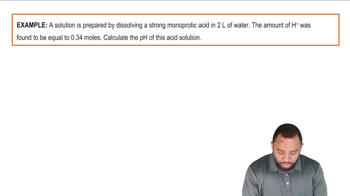
pH and its Calculation

pH is a measure of the hydrogen ion concentration in a solution, indicating its acidity or basicity. It is calculated using the formula pH = -log[H+]. Understanding how to calculate pH at different stages of a titration is crucial, as it helps determine the solution's behavior and the appropriate indicators to use.
추천 영상:
가이드 코스
02:15
pH Calculation Example

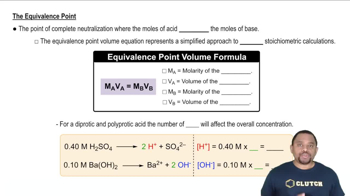
Titration and Equivalence Point

Titration is a quantitative analytical method used to determine the concentration of a solute in a solution. The equivalence point is reached when the amount of titrant added is stoichiometrically equivalent to the amount of substance in the sample. Recognizing the significance of the equivalence point is essential for understanding the changes in pH during the titration process.
추천 영상:
가이드 코스
03:06
Equivalence Point in Titration

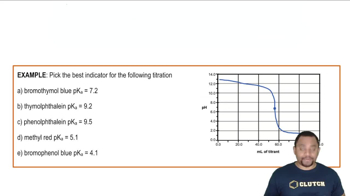
Indicators in Titration

Indicators are substances that change color at a specific pH range, signaling the endpoint of a titration. Choosing a suitable indicator depends on the pH at the equivalence point of the titration; it should change color close to this pH to provide an accurate visual cue. Familiarity with common indicators and their pH ranges is vital for effective titration analysis.
추천 영상:
가이드 코스
00:52
Best Indicator Example