
Ch.17 - Aqueous Ionic Equilibrium
Tro - Chemistry: A Molecular Approach 4th Edition
Tro4th EditionChemistry: A Molecular ApproachISBN: 9780134112831당신이 사용하는 게 아니라요?교과서 변경
17장, 문제 129

Calculate the solubility of CuX in a solution that is 0.150 M in NaCN. Ksp for CuX is 1.27⨉10-36.

검증된 단계별 안내
1
Identify the relevant chemical equilibrium: CuX(s) ⇌ Cu⁺(aq) + X⁻(aq).
Write the expression for the solubility product constant (Ksp): Ksp = [Cu⁺][X⁻].
Recognize that NaCN provides CN⁻ ions, which can complex with Cu⁺ to form Cu(CN)₂⁻, affecting the solubility of CuX.
Write the equilibrium expression for the complexation reaction: Cu⁺ + 2CN⁻ ⇌ Cu(CN)₂⁻, and note that this will reduce the concentration of free Cu⁺ ions.
Use the Ksp expression and the complexation equilibrium to set up equations that relate the solubility of CuX to the concentration of CN⁻, and solve for the solubility of CuX.

비슷한 문제에 대한 검증된 영상 답변:

이 영상 해법은 위 문제에 도움이 된다고 튜터들이 추천한 것입니다.
영상 길이:
8m
도움이 되었나요?

주요 개념

질문에 올바르게 답하기 위해 반드시 이해해야 하는 핵심 개념들은 다음과 같습니다.

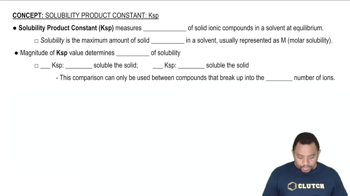
Solubility Product Constant (Ksp)

The solubility product constant (Ksp) is an equilibrium constant that applies to the solubility of sparingly soluble ionic compounds. It is defined as the product of the molar concentrations of the ions, each raised to the power of their coefficients in the balanced equation. For a compound like CuX, Ksp helps determine how much of the compound can dissolve in a solution before reaching saturation.
추천 영상:
가이드 코스
01:47
Solubility Product Constant

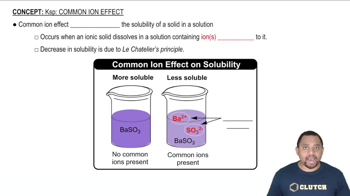
Common Ion Effect

The common ion effect refers to the decrease in solubility of an ionic compound when a common ion is added to the solution. In this case, the presence of NaCN introduces CN⁻ ions, which shifts the equilibrium of the dissolution of CuX, reducing its solubility. Understanding this effect is crucial for calculating the new solubility in the presence of a common ion.
추천 영상:
가이드 코스
02:53
Common Ion Effect

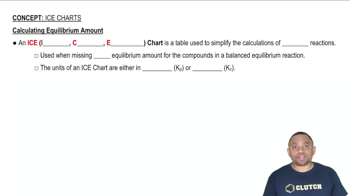
ICE Table (Initial, Change, Equilibrium)

An ICE table is a tool used to track the concentrations of reactants and products during a chemical reaction at different stages: Initial, Change, and Equilibrium. For solubility calculations, it helps organize the initial concentrations of ions, the changes that occur as the system reaches equilibrium, and the final concentrations. This systematic approach is essential for accurately determining the solubility of CuX in the given solution.
추천 영상:
가이드 코스
01:14
ICE Charts and Equilibrium Amount