
Ch.17 - Aqueous Ionic Equilibrium
Tro - Chemistry: A Molecular Approach 4th Edition
Tro4th EditionChemistry: A Molecular ApproachISBN: 9780134112831당신이 사용하는 게 아니라요?교과서 변경
17장, 문제 66a

Consider the curve shown here for the titration of a weak base with a strong acid and answer each question.
a. What is the pH and what is the volume of added acid at the equivalence point?

검증된 단계별 안내
1
1. The equivalence point in a titration is the point at which the amount of titrant added is enough to completely neutralize the analyte solution. In the case of a weak base being titrated with a strong acid, the equivalence point is reached when all of the weak base has reacted with the strong acid.
2. At the equivalence point, the solution will contain the conjugate acid of the weak base. Since the weak base has been completely neutralized, the pH of the solution will be determined by the concentration of this conjugate acid. The pH can be calculated using the expression for the acid dissociation constant (Ka) of the conjugate acid, which is given by Ka = [H+][A-]/[HA]. Here, [H+] is the concentration of hydrogen ions, [A-] is the concentration of the base, and [HA] is the concentration of the acid.
3. To find the volume of the added acid at the equivalence point, you need to use the concept of moles. At the equivalence point, the moles of the strong acid added will be equal to the moles of the weak base initially present in the solution. This can be calculated using the formula: moles = concentration x volume. Therefore, the volume of the strong acid added can be calculated by dividing the moles of the weak base by the concentration of the strong acid.
4. The pH at the equivalence point will be less than 7 because the conjugate acid of the weak base will hydrolyze water, producing hydronium ions and lowering the pH.
5. To summarize, to find the pH and the volume of the added acid at the equivalence point, you need to understand the concept of the equivalence point, use the expression for the acid dissociation constant (Ka), and apply the formula for calculating moles.

비슷한 문제에 대한 검증된 영상 답변:

이 영상 해법은 위 문제에 도움이 된다고 튜터들이 추천한 것입니다.
영상 길이:
2m
도움이 되었나요?

주요 개념

질문에 올바르게 답하기 위해 반드시 이해해야 하는 핵심 개념들은 다음과 같습니다.

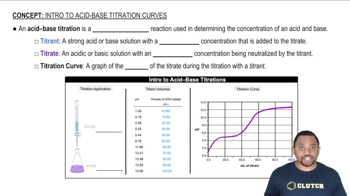
Titration

Titration is a quantitative analytical technique used to determine the concentration of a solute in a solution. It involves the gradual addition of a titrant (a solution of known concentration) to a sample until a reaction reaches completion, indicated by a color change or a pH change. In this case, the titration of a weak base with a strong acid will show a characteristic curve that helps identify the equivalence point.
추천 영상:
가이드 코스
03:04
Acid-Base Titration

Equivalence Point

The equivalence point in a titration is the stage at which the amount of titrant added is stoichiometrically equivalent to the amount of substance in the sample. For a weak base titrated with a strong acid, the pH at the equivalence point is typically less than 7 due to the formation of a weak conjugate acid. Understanding this point is crucial for determining the pH and volume of acid added.
추천 영상:
가이드 코스
01:07
At the Equivalence Point

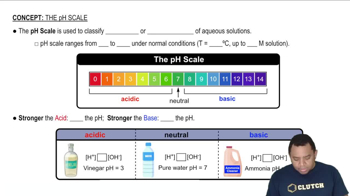
pH Scale

The pH scale measures the acidity or basicity of a solution, ranging from 0 to 14. A pH of 7 is neutral, values below 7 indicate acidic solutions, and values above 7 indicate basic solutions. In the context of titration, the pH changes significantly as the titrant is added, and understanding how to interpret these changes is essential for identifying the pH at the equivalence point.
추천 영상: