Consider the titration of a 20.0-mL sample of 0.105 M HC2H3O2 with 0.125 M NaOH. Determine each quantity. b. the volume of added base required to reach the equivalence point
Ch.17 - Aqueous Ionic Equilibrium
17장, 문제 69c
Consider the titration of a 25.0-mL sample of 0.115 M RbOH with 0.100 M HCl. Determine each quantity. c. the pH at 5.0 mL of added acid
검증된 단계별 안내1
Calculate the initial moles of RbOH using its concentration and volume: \( \text{moles of RbOH} = 0.115 \text{ M} \times 0.025 \text{ L} \).
Calculate the moles of HCl added using its concentration and the volume added: \( \text{moles of HCl} = 0.100 \text{ M} \times 0.005 \text{ L} \).
Determine the moles of RbOH remaining after reaction with HCl by subtracting the moles of HCl from the initial moles of RbOH.
Calculate the concentration of the remaining RbOH in the total volume of the solution (initial volume of RbOH + volume of HCl added).
Use the concentration of the remaining RbOH to find the pOH, and then convert it to pH using the relation \( \text{pH} = 14 - \text{pOH} \).

비슷한 문제에 대한 검증된 영상 답변:
이 영상 해법은 위 문제에 도움이 된다고 튜터들이 추천한 것입니다.
영상 길이:
4m주요 개념
질문에 올바르게 답하기 위해 반드시 이해해야 하는 핵심 개념들은 다음과 같습니다.
Titration
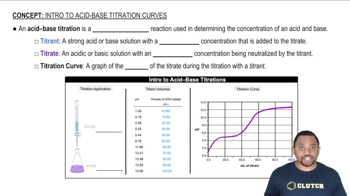
Titration is a quantitative analytical technique used to determine the concentration of a solute in a solution. It involves the gradual addition of a titrant (a solution of known concentration) to a sample until a reaction is complete, often indicated by a color change or pH change. In this case, RbOH, a strong base, is being titrated with HCl, a strong acid.
추천 영상:
가이드 코스
Acid-Base Titration
pH Calculation
pH is a measure of the acidity or basicity of a solution, calculated as the negative logarithm of the hydrogen ion concentration. In a titration, the pH changes as acid is added to a base. At the equivalence point, the pH is neutral, but before that point, the pH can be calculated using the concentrations of the remaining acid and base in the solution.
추천 영상:
가이드 코스
pH Calculation Example
Stoichiometry of Acid-Base Reactions
Stoichiometry in acid-base reactions involves the mole ratio of the acid and base reacting together. For strong acids and bases, the reaction is complete and can be represented by a balanced equation. In this case, the reaction between RbOH and HCl will determine how much of each reactant is present at various points in the titration, which is essential for calculating the pH at specific volumes of added acid.
추천 영상:
가이드 코스
Acid-Base Reaction
관련 실천
교과서 질문
1870
views
2
rank
교과서 질문
Consider the titration of a 25.0-mL sample of 0.115 M RbOH with 0.100 M HCl. Determine each quantity. b. the volume of added acid required to reach the equivalence point
1481
views
교과서 질문
A 30.0-mL sample of 0.165 M propanoic acid is titrated with 0.300 M KOH. Calculate the pH at each volume of added base: 0 mL, 5 mL, 10 mL, equivalence point, one-half equivalence point, 20 mL, 25 mL. Sketch the titration curve.
236
views
교과서 질문
A 30.0-mL sample of 0.165 M propanoic acid is titrated with 0.300 M KOH. Calculate the pH at each volume of added base: 0 mL.
322
views
교과서 질문
A 20.0-mL sample of 0.125 M HNO3 is titrated with 0.150 M NaOH. Calculate the pH for at least five different points throughout the titration curve and sketch the curve. Indicate the volume at the equivalence point on your graph.
509
views