Ch.17 - Aqueous Ionic Equilibrium
Tro - Chemistry: A Molecular Approach 4th Edition
Tro4th EditionChemistry: A Molecular ApproachISBN: 9780134112831당신이 사용하는 게 아니라요?교과서 변경
17장, 문제 106c

Determine the minimum concentration of the precipitating agent on the right to cause precipitation of the cation from the solution on the left. c. 0.0018 M AgNO3; RbCl

검증된 단계별 안내
1
Identify the ions involved in the precipitation reaction: Ag^+ from AgNO_3 and Cl^- from RbCl.
Write the balanced chemical equation for the precipitation reaction: Ag^+ (aq) + Cl^- (aq) \(\rightarrow\) AgCl (s).
Determine the solubility product constant (K_{sp}) for AgCl, which is a known value from tables.
Use the expression for the solubility product: K_{sp} = [Ag^+][Cl^-].
Rearrange the expression to solve for the minimum concentration of Cl^- needed to cause precipitation: [Cl^-] = \(\frac{K_{sp}\)}{[Ag^+]} and substitute the known values.

비슷한 문제에 대한 검증된 영상 답변:

이 영상 해법은 위 문제에 도움이 된다고 튜터들이 추천한 것입니다.
영상 길이:
3m
도움이 되었나요?

주요 개념

질문에 올바르게 답하기 위해 반드시 이해해야 하는 핵심 개념들은 다음과 같습니다.

Precipitation Reaction

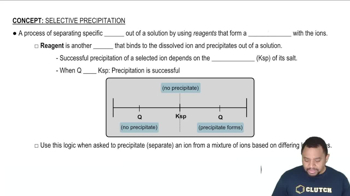
A precipitation reaction occurs when two soluble salts react in solution to form an insoluble compound, known as a precipitate. This process is driven by the formation of a solid that separates from the liquid phase, often indicated by a change in color or turbidity. Understanding the solubility rules and the specific ions involved is crucial for predicting whether a precipitate will form.
추천 영상:
가이드 코스
01:53
Selective Precipitation

Solubility Product Constant (Ksp)

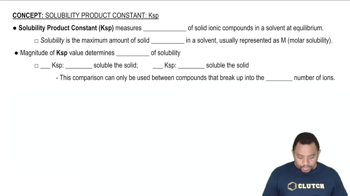
The solubility product constant (Ksp) is an equilibrium constant that quantifies the solubility of a sparingly soluble ionic compound. It is defined as the product of the molar concentrations of the ions, each raised to the power of their coefficients in the balanced equation. For precipitation to occur, the product of the concentrations of the ions in solution must exceed the Ksp value of the precipitate.
추천 영상:
가이드 코스
01:47
Solubility Product Constant

Concentration and Molarity

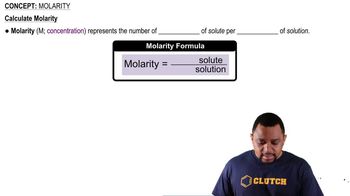
Concentration refers to the amount of a substance (solute) present in a given volume of solution, commonly expressed in molarity (M), which is moles of solute per liter of solution. Understanding how to calculate and manipulate concentrations is essential for determining the minimum amount of a precipitating agent needed to initiate precipitation. This involves stoichiometric relationships and the concept of limiting reagents in chemical reactions.
추천 영상:
가이드 코스
00:53
Molarity Concept