Ch.17 - Aqueous Ionic Equilibrium
Tro - Chemistry: A Molecular Approach 4th Edition
Tro4th EditionChemistry: A Molecular ApproachISBN: 9780134112831당신이 사용하는 게 아니라요?교과서 변경
17장, 문제 62b

Two 25.0-mL samples, one 0.100 M HCl and the other 0.100 M HF, are titrated with 0.200 M KOH. b. Is the pH at the equivalence point for each titration acidic, basic, or neutral?

검증된 단계별 안내
1
insert step 1> Determine the nature of the reaction for each titration. HCl is a strong acid, and HF is a weak acid. Both are being titrated with KOH, a strong base.
insert step 2> For the HCl titration, since HCl is a strong acid, it will completely dissociate in water. The reaction with KOH will produce water and KCl, a neutral salt.
insert step 3> At the equivalence point of the HCl titration, the solution will be neutral because the strong acid and strong base completely neutralize each other, resulting in a pH of 7.
insert step 4> For the HF titration, HF is a weak acid and does not completely dissociate in water. The reaction with KOH will produce water and KF, a salt that can hydrolyze to form a basic solution.
insert step 5> At the equivalence point of the HF titration, the solution will be basic because the conjugate base (F-) from the weak acid (HF) will react with water to form OH- ions, increasing the pH above 7.

비슷한 문제에 대한 검증된 영상 답변:

이 영상 해법은 위 문제에 도움이 된다고 튜터들이 추천한 것입니다.
영상 길이:
1m
도움이 되었나요?

주요 개념

질문에 올바르게 답하기 위해 반드시 이해해야 하는 핵심 개념들은 다음과 같습니다.

Strong vs. Weak Acids

Strong acids, like HCl, completely dissociate in solution, while weak acids, such as HF, only partially dissociate. This difference affects the pH at the equivalence point during titration. At the equivalence point, the strong acid will yield a neutral solution, while the weak acid will result in a solution that is more acidic due to the presence of undissociated acid molecules.
추천 영상:
가이드 코스
02:19
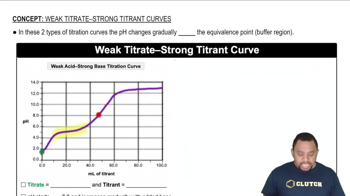
Weak Acid-Strong Base Titration Curve

Titration and Equivalence Point

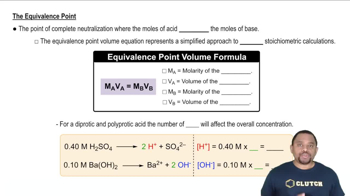
Titration is a technique used to determine the concentration of an acid or base by neutralizing it with a base or acid of known concentration. The equivalence point is reached when the amount of titrant added is stoichiometrically equivalent to the amount of substance being titrated. This point is crucial for determining the resulting pH of the solution, which varies depending on the strength of the acid or base involved.
추천 영상:
가이드 코스
03:06
Equivalence Point in Titration

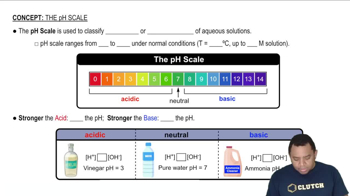
pH and Its Interpretation

pH is a measure of the hydrogen ion concentration in a solution, indicating its acidity or basicity. A pH less than 7 is considered acidic, a pH of 7 is neutral, and a pH greater than 7 is basic. Understanding how the pH changes at the equivalence point of different acid-base titrations is essential for predicting the nature of the resulting solution.
추천 영상: