Ch.17 - Aqueous Ionic Equilibrium
Tro - Chemistry: A Molecular Approach 4th Edition
Tro4th EditionChemistry: A Molecular ApproachISBN: 9780134112831당신이 사용하는 게 아니라요?교과서 변경
17장, 문제 39c

Use the Henderson–Hasselbalch equation to calculate the pH of each solution. c. a solution that contains 10.0 g of HC2H3O2 and 10.0 g of NaC2H3O2 in 150.0 mL of solution

검증된 단계별 안내
1
Step 1: The Henderson-Hasselbalch equation is given by pH = pKa + log([A-]/[HA]). Here, [A-] is the concentration of the base (NaC2H3O2) and [HA] is the concentration of the acid (HC2H3O2).
Step 2: First, calculate the molar mass of HC2H3O2 and NaC2H3O2. Then, use these values to convert the given masses (10.0 g each) into moles.
Step 3: Next, calculate the molarities of HC2H3O2 and NaC2H3O2 by dividing the number of moles by the volume of the solution in liters (150.0 mL = 0.150 L).
Step 4: The pKa value for HC2H3O2 (acetic acid) is 4.76. Substitute the calculated molarities and the pKa value into the Henderson-Hasselbalch equation.
Step 5: Solve the equation to find the pH of the solution. Remember, the log function in the equation is base 10.

비슷한 문제에 대한 검증된 영상 답변:

이 영상 해법은 위 문제에 도움이 된다고 튜터들이 추천한 것입니다.
도움이 되었나요?

주요 개념

질문에 올바르게 답하기 위해 반드시 이해해야 하는 핵심 개념들은 다음과 같습니다.

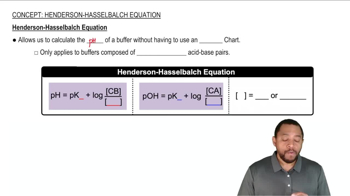
Henderson-Hasselbalch Equation

The Henderson-Hasselbalch equation is a mathematical formula used to calculate the pH of a buffer solution. It is expressed as pH = pKa + log([A-]/[HA]), where pKa is the negative logarithm of the acid dissociation constant, [A-] is the concentration of the conjugate base, and [HA] is the concentration of the weak acid. This equation is particularly useful for solutions containing a weak acid and its conjugate base.
추천 영상:
가이드 코스
02:40
Henderson-Hasselbalch Equation

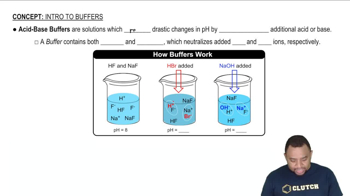
Buffer Solutions

Buffer solutions are mixtures that can resist changes in pH upon the addition of small amounts of acid or base. They typically consist of a weak acid and its conjugate base, which work together to neutralize added acids or bases. In the context of the question, the acetic acid (HC2H3O2) and sodium acetate (NaC2H3O2) form a buffer system that helps maintain a stable pH.
추천 영상:
가이드 코스
03:02
Buffer Solutions

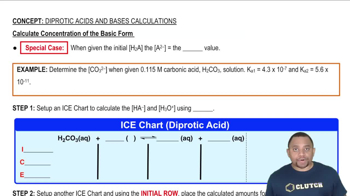
Concentration Calculations

To apply the Henderson-Hasselbalch equation, it is essential to calculate the concentrations of the acid and its conjugate base in the solution. Concentration is defined as the amount of solute divided by the volume of solution. In this case, the masses of HC2H3O2 and NaC2H3O2 must be converted to moles using their molar masses, and then divided by the total volume of the solution (in liters) to find the necessary concentrations for the equation.
추천 영상:
가이드 코스
07:35
Calculate Concentration of the Basic Form