Ch.18 - Free Energy and Thermodynamics
Tro - Chemistry: A Molecular Approach 4th Edition
Tro4th EditionChemistry: A Molecular ApproachISBN: 9780134112831당신이 사용하는 게 아니라요?교과서 변경
18장, 문제 72

Consider the reaction: CO2(g) + CCl4(g) ⇌ 2 COCl2(g) Calculate ΔG for this reaction at 25 °C under the following conditions: i. PCO2 = 0.112 atm ii. PCCl4 = 0.174 atm iii. PCOCl2 = 0.744 atm

검증된 단계별 안내
1
Identify the reaction: CO_2(g) + CCl_4(g) ⇌ 2 COCl_2(g).
Use the formula for the reaction quotient, Q: Q = \(\frac{{(P_{COCl_2}\))^2}}{{P_{CO_2} \(\cdot\) P_{CCl_4}}}.
Substitute the given partial pressures into the expression for Q: P_{CO_2} = 0.112 \(\text{ atm}\), P_{CCl_4} = 0.174 \(\text{ atm}\), P_{COCl_2} = 0.744 \(\text{ atm}\).
Calculate the standard Gibbs free energy change, \(\Delta\) G^\(\circ\), using the equation \(\Delta\) G = \(\Delta\) G^\(\circ\) + RT \(\ln\) Q, where R = 8.314 \(\text{ J/mol·K}\) and T = 298 \(\text{ K}\).
Determine \(\Delta\) G by substituting the calculated Q and known values into the equation.

비슷한 문제에 대한 검증된 영상 답변:

이 영상 해법은 위 문제에 도움이 된다고 튜터들이 추천한 것입니다.
영상 길이:
8m

주요 개념

질문에 올바르게 답하기 위해 반드시 이해해야 하는 핵심 개념들은 다음과 같습니다.

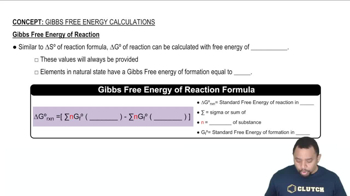
Gibbs Free Energy (ΔG)

Gibbs Free Energy (ΔG) is a thermodynamic potential that measures the maximum reversible work obtainable from a thermodynamic system at constant temperature and pressure. It is a crucial concept in predicting the spontaneity of a reaction; a negative ΔG indicates that a reaction can occur spontaneously, while a positive ΔG suggests non-spontaneity. The relationship between ΔG, enthalpy, and entropy is given by the equation ΔG = ΔH - TΔS.
추천 영상:
가이드 코스
01:51
Gibbs Free Energy of Reactions

Equilibrium Constant (K)

The equilibrium constant (K) is a dimensionless value that expresses the ratio of the concentrations of products to reactants at equilibrium for a given reaction at a specific temperature. For the reaction CO2(g) + CCl4(g) ⇌ 2 COCl2(g), K can be calculated using the partial pressures of the gases involved. Understanding K is essential for calculating ΔG, as the relationship ΔG = ΔG° + RT ln(Q) connects the standard Gibbs free energy change (ΔG°) to the reaction quotient (Q) and K.
추천 영상:
가이드 코스
01:14
Equilibrium Constant K

Reaction Quotient (Q)

The reaction quotient (Q) is a measure of the relative amounts of products and reactants present in a reaction at any point in time, calculated using the same expression as the equilibrium constant (K). It helps determine the direction in which a reaction will proceed to reach equilibrium. If Q < K, the reaction will shift to the right (toward products), while if Q > K, it will shift to the left (toward reactants). In this question, Q is calculated using the given partial pressures.
추천 영상:
가이드 코스
00:49
Reaction Quotient Q