Ch.18 - Free Energy and Thermodynamics
Tro - Chemistry: A Molecular Approach 4th Edition
Tro4th EditionChemistry: A Molecular ApproachISBN: 9780134112831당신이 사용하는 게 아니라요?교과서 변경
18장, 문제 76a

Consider the reaction: I2(g) + Cl2(g) ⇌ 2 ICl(g) Kp = 81.9 at 25 °C Calculate ΔGrxn for the reaction at 25 °C under each of the following conditions: a. standard conditions

검증된 단계별 안내
1
Identify the given values: The equilibrium constant, Kp, is 81.9, and the temperature, T, is 25 °C (which is 298 K when converted to Kelvin).
Recall the relationship between the Gibbs free energy change (ΔG) and the equilibrium constant (K) at a given temperature (T) using the formula: ΔG = -RT ln(K), where R is the gas constant (8.314 J/mol·K).
Convert the temperature from Celsius to Kelvin by adding 273.15 to the Celsius temperature.
Substitute the values of R, T, and K into the formula to calculate ΔG under standard conditions.
Since the reaction is at standard conditions, the partial pressures of the reactants and products are 1 atm, and thus the reaction quotient, Q, equals 1. This simplifies the calculation as ln(1) equals 0, which directly gives ΔG = -RT ln(K).

비슷한 문제에 대한 검증된 영상 답변:

이 영상 해법은 위 문제에 도움이 된다고 튜터들이 추천한 것입니다.
영상 길이:
3m

주요 개념

질문에 올바르게 답하기 위해 반드시 이해해야 하는 핵심 개념들은 다음과 같습니다.

Gibbs Free Energy (ΔG)

Gibbs Free Energy (ΔG) is a thermodynamic potential that measures the maximum reversible work obtainable from a thermodynamic system at constant temperature and pressure. It is a crucial concept in predicting the spontaneity of a reaction; a negative ΔG indicates a spontaneous process, while a positive ΔG suggests non-spontaneity. The relationship between ΔG and the equilibrium constant (K) is given by the equation ΔG = -RT ln(K), where R is the universal gas constant and T is the temperature in Kelvin.
추천 영상:
가이드 코스
01:51
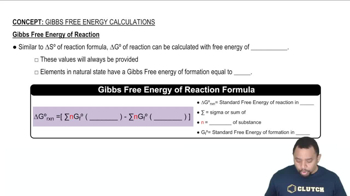
Gibbs Free Energy of Reactions

Equilibrium Constant (Kp)

The equilibrium constant (Kp) is a dimensionless number that expresses the ratio of the concentrations of products to reactants at equilibrium for a given reaction at a specific temperature. For the reaction I2(g) + Cl2(g) ⇌ 2 ICl(g), Kp = 81.9 indicates that at equilibrium, the concentration of ICl is significantly higher than that of I2 and Cl2, suggesting that the formation of ICl is favored under standard conditions. This constant is essential for calculating ΔG under different conditions.
추천 영상:
가이드 코스
03:20
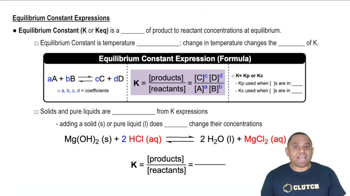
Equilibrium Constant Expressions

Standard Conditions

Standard conditions refer to a set of specific parameters used to measure and compare thermodynamic properties, typically defined as 1 bar of pressure and a specified temperature, usually 25 °C (298 K). Under these conditions, the standard Gibbs free energy change (ΔG°) can be calculated using the equilibrium constant (Kp) and is essential for determining the spontaneity of reactions. Understanding standard conditions is vital for accurately calculating ΔG for reactions in a consistent manner.
추천 영상:
가이드 코스
01:10
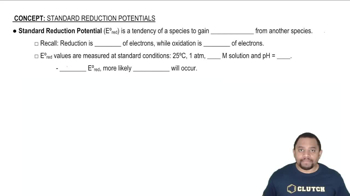
Standard Reduction Potentials