Ch.18 - Free Energy and Thermodynamics
Tro - Chemistry: A Molecular Approach 4th Edition
Tro4th EditionChemistry: A Molecular ApproachISBN: 9780134112831당신이 사용하는 게 아니라요?교과서 변경
18장, 문제 69c

Consider the sublimation of iodine at 25.0 °C : I2(s) → I2(g) c. Explain why iodine spontaneously sublimes in open air at 25.0 °C

검증된 단계별 안내
1
1. Sublimation is the process by which a substance changes from a solid to a gas without passing through the liquid phase. For iodine, this process can occur at room temperature (25.0 °C).
2. The spontaneity of a process is determined by the change in Gibbs free energy (ΔG). If ΔG is negative, the process is spontaneous. The Gibbs free energy is given by the equation ΔG = ΔH - TΔS, where ΔH is the change in enthalpy, T is the temperature in Kelvin, and ΔS is the change in entropy.
3. In the case of iodine sublimation, the process is endothermic (ΔH > 0) because energy is absorbed to break the intermolecular forces holding the iodine molecules together in the solid phase. However, the process leads to a significant increase in entropy (ΔS > 0) because gas particles are much more disordered than solid particles.
4. At room temperature, the TΔS term in the Gibbs free energy equation is large enough to make ΔG negative, despite the positive ΔH. This is because the increase in disorder (entropy) is a dominant factor at this temperature.
5. Therefore, iodine spontaneously sublimes in open air at 25.0 °C because the process results in a decrease in Gibbs free energy, primarily due to the significant increase in entropy when iodine changes from a solid to a gas.

비슷한 문제에 대한 검증된 영상 답변:

이 영상 해법은 위 문제에 도움이 된다고 튜터들이 추천한 것입니다.
영상 길이:
1m

주요 개념

질문에 올바르게 답하기 위해 반드시 이해해야 하는 핵심 개념들은 다음과 같습니다.

Sublimation

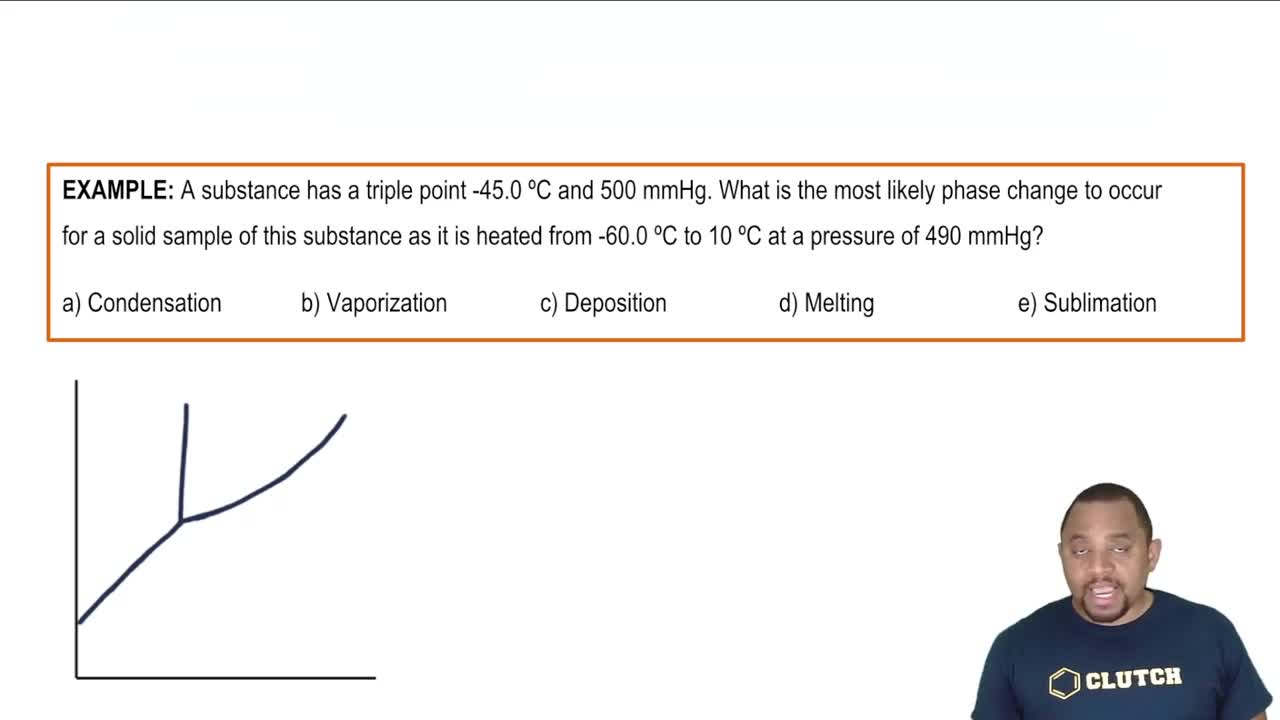
Sublimation is the phase transition in which a substance changes directly from a solid to a gas without passing through the liquid phase. This process occurs when the molecules in the solid gain enough energy to overcome intermolecular forces and escape into the gas phase. For iodine, sublimation is favored at certain temperatures and pressures, particularly when the solid is exposed to open air.
추천 영상:
가이드 코스
01:52
Sublimation Phase Change Example

Vapor Pressure

Vapor pressure is the pressure exerted by a vapor in equilibrium with its solid or liquid phase at a given temperature. For iodine, at 25.0 °C, the vapor pressure is significant enough to allow iodine molecules to escape from the solid phase into the gas phase. When the vapor pressure exceeds the atmospheric pressure, sublimation occurs spontaneously, leading to the transition of solid iodine to gaseous iodine.
추천 영상:
가이드 코스
02:40
Raoult's Law and Vapor Pressure

Thermodynamics and Spontaneity

Thermodynamics helps determine whether a process is spontaneous based on changes in enthalpy and entropy. For iodine subliming at 25.0 °C, the process is driven by an increase in entropy, as gas molecules have greater disorder than solid molecules. The Gibbs free energy change (ΔG) for sublimation is negative under these conditions, indicating that the process occurs spontaneously in open air.
추천 영상:
가이드 코스
04:20
Spontaneity of Processes