Ch.18 - Free Energy and Thermodynamics
Tro - Chemistry: A Molecular Approach 4th Edition
Tro4th EditionChemistry: A Molecular ApproachISBN: 9780134112831당신이 사용하는 게 아니라요?교과서 변경
18장, 문제 57

Find ΔS° for the formation of CH2Cl2(g) from its gaseous elements in their standard states. Rationalize the sign of ΔS°.

검증된 단계별 안내
1
Identify the reaction for the formation of CH2Cl2(g) from its gaseous elements: C(graphite) + 2H2(g) + 2Cl2(g) -> CH2Cl2(g).
Use the standard entropy values (S°) for each substance involved in the reaction. These values are typically found in a table of thermodynamic data.
Calculate the change in entropy (ΔS°) for the reaction using the formula: ΔS° = ΣS°(products) - ΣS°(reactants).
Substitute the standard entropy values into the formula to find ΔS°.
Rationalize the sign of ΔS°: Consider the change in the number of moles of gas and the complexity of the molecules involved. Formation of CH2Cl2(g) from simpler gaseous elements may lead to a decrease in entropy due to a decrease in the number of gas molecules.

비슷한 문제에 대한 검증된 영상 답변:

이 영상 해법은 위 문제에 도움이 된다고 튜터들이 추천한 것입니다.
영상 길이:
3m

주요 개념

질문에 올바르게 답하기 위해 반드시 이해해야 하는 핵심 개념들은 다음과 같습니다.

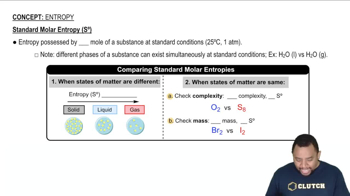
Standard Entropy (ΔS°)

Standard entropy (ΔS°) is a measure of the disorder or randomness of a system at standard conditions (1 bar, 25°C). It quantifies the amount of energy unavailable for doing work due to the dispersal of energy in a system. A positive ΔS° indicates an increase in disorder, while a negative ΔS° suggests a decrease in disorder.
추천 영상:
가이드 코스
03:33
Standard Molar Entropy

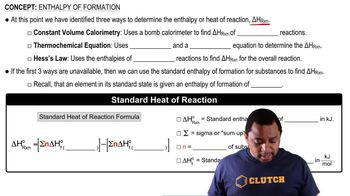
Formation Reaction

A formation reaction is a chemical reaction in which one mole of a compound is formed from its constituent elements in their standard states. For example, the formation of dichloromethane (CH2Cl2) involves combining carbon, hydrogen, and chlorine gases. The standard enthalpy and entropy changes for this reaction are crucial for calculating thermodynamic properties.
추천 영상:
가이드 코스
02:34
Enthalpy of Formation

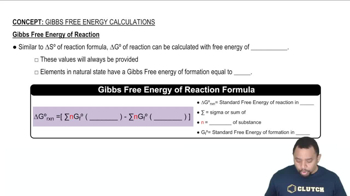
Gibbs Free Energy and Spontaneity

Gibbs free energy (G) combines enthalpy and entropy to determine the spontaneity of a reaction at constant temperature and pressure. The change in Gibbs free energy (ΔG) is given by the equation ΔG = ΔH - TΔS. A negative ΔG indicates a spontaneous process, while the sign of ΔS helps rationalize whether the reaction increases or decreases disorder, influencing the overall spontaneity.
추천 영상:
가이드 코스
01:51
Gibbs Free Energy of Reactions