
Ch.18 - Free Energy and Thermodynamics
Tro - Chemistry: A Molecular Approach 4th Edition
Tro4th EditionChemistry: A Molecular ApproachISBN: 9780134112831당신이 사용하는 게 아니라요?교과서 변경
18장, 문제 42c

Given the values of ΔH°rxn, ΔS°rxn, and T, determine ΔSuniv and predict whether or not each reaction is spontaneous. (Assume that all reactants and products are in their standard states.) c. ΔH°rxn = +95 kJ; ΔS°rxn = -157 J/K; T = 298 K

검증된 단계별 안내
1
First, we need to convert ΔH°rxn from kJ to J because ΔS°rxn is given in J/K. We can do this by multiplying the given ΔH°rxn by 1000. So, ΔH°rxn = +95 kJ * 1000 = +95000 J.
Next, we calculate ΔSuniv using the formula ΔSuniv = ΔS°rxn - (ΔH°rxn/T). Plug in the given values: ΔSuniv = -157 J/K - (+95000 J/298 K).
Calculate the value of ΔSuniv from the above expression.
If ΔSuniv is positive, the reaction is spontaneous. If ΔSuniv is negative, the reaction is non-spontaneous.
Finally, based on the value of ΔSuniv, predict whether the reaction is spontaneous or not.

비슷한 문제에 대한 검증된 영상 답변:

이 영상 해법은 위 문제에 도움이 된다고 튜터들이 추천한 것입니다.
영상 길이:
5m

주요 개념

질문에 올바르게 답하기 위해 반드시 이해해야 하는 핵심 개념들은 다음과 같습니다.

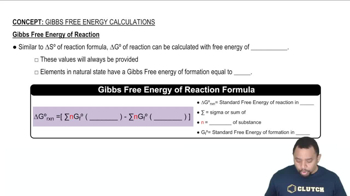
Gibbs Free Energy

Gibbs Free Energy (G) is a thermodynamic potential that helps predict the spontaneity of a reaction at constant temperature and pressure. It is calculated using the equation ΔG = ΔH - TΔS, where ΔH is the change in enthalpy, T is the temperature in Kelvin, and ΔS is the change in entropy. A negative ΔG indicates a spontaneous reaction, while a positive ΔG suggests non-spontaneity.
추천 영상:
가이드 코스
01:51
Gibbs Free Energy of Reactions

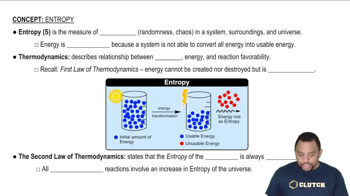
Entropy (ΔS)

Entropy (ΔS) is a measure of the disorder or randomness in a system. In the context of a chemical reaction, a positive ΔS indicates an increase in disorder, which favors spontaneity. Conversely, a negative ΔS suggests a decrease in disorder, which can hinder spontaneity. The change in entropy is crucial for determining the overall spontaneity of a reaction when combined with enthalpy changes.
추천 영상:
가이드 코스
02:46
Entropy in Thermodynamics

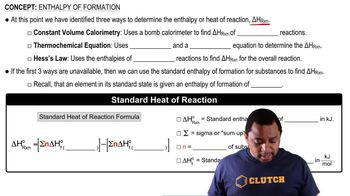
Enthalpy (ΔH)

Enthalpy (ΔH) is a measure of the total heat content of a system and reflects the energy absorbed or released during a reaction. A positive ΔH indicates that the reaction is endothermic, absorbing heat from the surroundings, while a negative ΔH indicates an exothermic reaction, releasing heat. The sign and magnitude of ΔH are essential for evaluating the energy changes that influence the spontaneity of a reaction in conjunction with entropy.
추천 영상:
가이드 코스
02:34
Enthalpy of Formation