Ch.18 - Free Energy and Thermodynamics
Tro - Chemistry: A Molecular Approach 4th Edition
Tro4th EditionChemistry: A Molecular ApproachISBN: 9780134112831당신이 사용하는 게 아니라요?교과서 변경
18장, 문제 85

Our atmosphere is composed primarily of nitrogen and oxygen, which coexist at 25 °C without reacting to any significant extent. However, the two gases can react to form nitrogen monoxide according to the reaction: N2(g) + O2(g) → 2 NO(g). a. Calculate ΔG° and Kp for this reaction at 298 K. Is the reaction spontaneous? b. Estimate ΔG° at 2000 K. Does the reaction become more spontaneous as temperature increases?

검증된 단계별 안내
1
insert step 1: Identify the standard Gibbs free energy change (ΔG°) equation: ΔG° = ΔH° - TΔS°. You will need the standard enthalpy change (ΔH°) and the standard entropy change (ΔS°) for the reaction.
insert step 2: Look up or calculate the standard enthalpy change (ΔH°) and the standard entropy change (ΔS°) for the reaction using standard thermodynamic tables.
insert step 3: Calculate ΔG° at 298 K using the equation from step 1.
insert step 4: Use the relationship between ΔG° and the equilibrium constant (Kp) at a given temperature: ΔG° = -RT ln(Kp), where R is the gas constant and T is the temperature in Kelvin. Solve for Kp.
insert step 5: To estimate ΔG° at 2000 K, use the same equation from step 1, assuming ΔH° and ΔS° are approximately constant over the temperature range. Compare the ΔG° values at 298 K and 2000 K to determine if the reaction becomes more spontaneous at higher temperatures.

주요 개념

질문에 올바르게 답하기 위해 반드시 이해해야 하는 핵심 개념들은 다음과 같습니다.

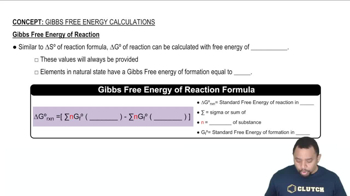
Gibbs Free Energy (ΔG)

Gibbs Free Energy (ΔG) is a thermodynamic potential that helps predict the spontaneity of a reaction at constant temperature and pressure. A negative ΔG indicates that a reaction is spontaneous, while a positive ΔG suggests non-spontaneity. The standard Gibbs free energy change (ΔG°) is calculated using standard enthalpy and entropy values, providing insight into the favorability of a reaction under standard conditions.
추천 영상:
가이드 코스
01:51
Gibbs Free Energy of Reactions

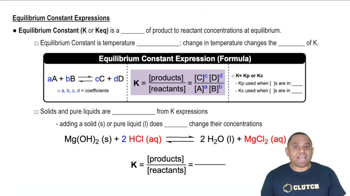
Equilibrium Constant (Kp)

The equilibrium constant (Kp) is a dimensionless value that expresses the ratio of the concentrations of products to reactants at equilibrium for a given reaction at a specific temperature. For the reaction N2(g) + O2(g) → 2 NO(g), Kp can be calculated using the partial pressures of the gases involved. A larger Kp value indicates a greater tendency for the reaction to favor product formation at equilibrium.
추천 영상:
가이드 코스
03:20
Equilibrium Constant Expressions

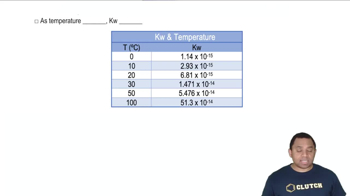
Temperature Dependence of Spontaneity

The spontaneity of a reaction can be temperature-dependent, as described by the Gibbs free energy equation: ΔG = ΔH - TΔS. Here, ΔH is the change in enthalpy, ΔS is the change in entropy, and T is the temperature in Kelvin. As temperature increases, the TΔS term can become significant, potentially making a reaction more spontaneous if ΔS is positive, indicating an increase in disorder.
추천 영상:
가이드 코스
01:24
Kw Temperature Dependence