Use data from Appendix IIB to calculate ΔS°rxn for each of the reactions. In each case, try to rationalize the sign of ΔS°rxn. b. Cr2O3(s) + 3 CO(g) → 2 Cr(s) + 3 CO2(g)
Ch.18 - Free Energy and Thermodynamics
18장, 문제 55d
Use data from Appendix IIB to calculate ΔS°rxn for each of the reactions. In each case, try to rationalize the sign of ΔS°rxn. d. 2 H2S(g) + 3 O2(g) → 2 H2O(l) + 2 SO2(g)
검증된 단계별 안내1
Identify the standard entropy values (S°) for each reactant and product from Appendix IIB.
Write the balanced chemical equation: 2 H2S(g) + 3 O2(g) → 2 H2O(l) + 2 SO2(g).
Calculate the total standard entropy of the reactants: (2 * S°(H2S)) + (3 * S°(O2)).
Calculate the total standard entropy of the products: (2 * S°(H2O)) + (2 * S°(SO2)).
Determine the change in standard entropy (ΔS°rxn) using the formula: ΔS°rxn = ΣS°(products) - ΣS°(reactants).

비슷한 문제에 대한 검증된 영상 답변:
이 영상 해법은 위 문제에 도움이 된다고 튜터들이 추천한 것입니다.
영상 길이:
3m주요 개념
질문에 올바르게 답하기 위해 반드시 이해해야 하는 핵심 개념들은 다음과 같습니다.
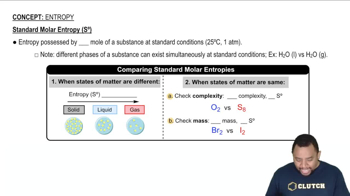
Standard Entropy (ΔS°)
Standard entropy (ΔS°) is a measure of the disorder or randomness in a system at standard conditions (1 atm, 25°C). It quantifies the amount of energy that is unavailable to do work due to the dispersal of energy among the particles in a substance. Higher entropy values indicate greater disorder, while lower values suggest more order.
추천 영상:
가이드 코스
Standard Molar Entropy
Entropy Change in Reactions
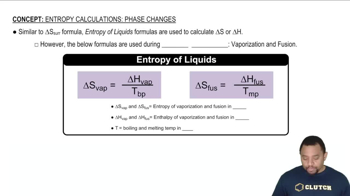
The change in entropy (ΔS°rxn) for a chemical reaction is calculated by considering the difference in standard entropies of the products and reactants. It is given by the equation ΔS°rxn = ΣS°(products) - ΣS°(reactants). A positive ΔS°rxn indicates an increase in disorder, while a negative value suggests a decrease in disorder during the reaction.
추천 영상:
가이드 코스
Entropy in Phase Changes
Rationalizing the Sign of ΔS°rxn
Rationalizing the sign of ΔS°rxn involves analyzing the physical states and the number of moles of reactants and products. Generally, reactions that produce gases from solids or liquids, or increase the number of gas molecules, tend to have a positive ΔS°rxn. Conversely, reactions that produce fewer gas molecules or convert gases to liquids or solids typically exhibit a negative ΔS°rxn.
추천 영상:
가이드 코스
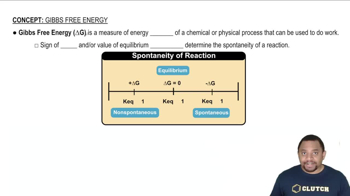
Spontaneity of Reactions
관련 실천
교과서 질문
669
views
교과서 질문
Use data from Appendix IIB to calculate ΔS°rxn for each of the reactions. In each case, try to rationalize the sign of ΔS°rxn . b. C(s) + H2O(g) → CO(g) + H2(g)
2217
views
1
rank
교과서 질문
Use data from Appendix IIB to calculate ΔS°rxn for each of the reactions. In each case, try to rationalize the sign of ΔS°rxn. c. SO2(g) + 1/2 O2(g) → SO3(g)
362
views
교과서 질문
Use data from Appendix IIB to calculate ΔS°rxn for each of the reactions. In each case, try to rationalize the sign of ΔS°rxn. c. CO(g) + H2O(g) → H2(g) + CO2(g)
445
views
교과서 질문
Use data from Appendix IIB to calculate ΔS°rxn for each of the reactions. In each case, try to rationalize the sign of ΔS°rxn . a. 3 NO2(g) + H2O(l) → 2 HNO3(aq) + NO(g)
479
views