
Ch.19 - Electrochemistry
Tro - Chemistry: A Molecular Approach 4th Edition
Tro4th EditionChemistry: A Molecular ApproachISBN: 9780134112831당신이 사용하는 게 아니라요?교과서 변경
19장, 문제 116c

A rechargeable battery is constructed based on a concentration cell constructed of two Ag/Ag+ half-cells. The volume of each half-cell is 2.0 L, and the concentrations of Ag+ in the half-cells are 1.25 M and 1.0 × 10⁻³ M. c. Upon recharging, how long would it take to redissolve 1.00 × 10² g of silver at a charging current of 10.0 amps?

검증된 단계별 안내
1
Calculate the number of moles of silver (Ag) that need to be redissolved using the formula: \( \text{moles of Ag} = \frac{\text{mass of Ag}}{\text{molar mass of Ag}} \). The molar mass of silver is approximately 107.87 g/mol.
Use Faraday's laws of electrolysis to relate the charge required to redissolve the silver. The formula is: \( Q = n \times F \), where \( Q \) is the total charge in coulombs, \( n \) is the number of moles of electrons, and \( F \) is Faraday's constant (approximately 96485 C/mol). Since each Ag atom requires one electron to be reduced, \( n \) is equal to the moles of Ag.
Determine the time required to supply this charge using the formula: \( t = \frac{Q}{I} \), where \( t \) is the time in seconds, \( Q \) is the charge in coulombs, and \( I \) is the current in amperes (10.0 A in this case).
Convert the time from seconds to a more convenient unit if necessary, such as minutes or hours, by using appropriate conversion factors.
Summarize the process: Calculate moles of Ag, determine the charge needed using Faraday's law, and then find the time required using the current provided.

비슷한 문제에 대한 검증된 영상 답변:

이 영상 해법은 위 문제에 도움이 된다고 튜터들이 추천한 것입니다.
영상 길이:
5m
도움이 되었나요?

주요 개념

질문에 올바르게 답하기 위해 반드시 이해해야 하는 핵심 개념들은 다음과 같습니다.

Concentration Cells

A concentration cell is a type of electrochemical cell where two half-cells have different concentrations of the same ion. The cell generates an electromotive force (EMF) due to the difference in concentration, driving the spontaneous flow of electrons from the higher concentration to the lower concentration. This principle is crucial for understanding how rechargeable batteries operate, particularly in the context of redox reactions.
추천 영상:
가이드 코스
01:21
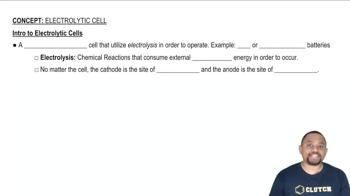
The Electrolytic Cell

Faraday's Law of Electrolysis

Faraday's Law states that the amount of substance transformed during electrolysis is directly proportional to the quantity of electric charge passed through the cell. This law allows us to calculate the mass of a substance, such as silver, that can be deposited or dissolved during the charging process, using the formula: mass = (current × time × molar mass) / (n × F), where n is the number of moles of electrons transferred and F is Faraday's constant.
추천 영상:
가이드 코스
01:40
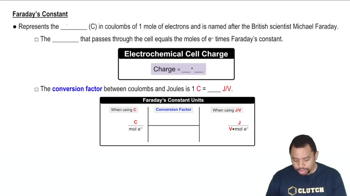
Faraday's Constant in Electrochemistry

Current and Time Relationship

The relationship between current, time, and charge is fundamental in electrochemistry. Current (measured in amperes) is defined as the flow of electric charge per unit time. To determine how long it takes to dissolve a specific mass of silver, one must relate the total charge required (calculated from the mass of silver) to the current applied, using the formula: time = total charge / current.
추천 영상:
가이드 코스
02:16
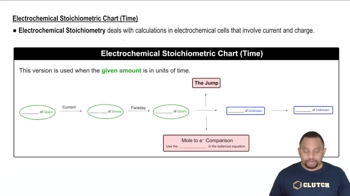
Electrochemical Stoichiometric Chart (Time)