Ch.19 - Electrochemistry
Tro - Chemistry: A Molecular Approach 4th Edition
Tro4th EditionChemistry: A Molecular ApproachISBN: 9780134112831당신이 사용하는 게 아니라요?교과서 변경
19장, 문제 70

Calculate the equilibrium constant for the reaction between Fe2+(aq) and Zn(s) (at 25 °C).

검증된 단계별 안내
1
Identify the half-reactions involved in the process. For the reaction between Fe2+(aq) and Zn(s), the half-reactions are: Zn(s) → Zn2+(aq) + 2e- (oxidation) and Fe2+(aq) + 2e- → Fe(s) (reduction).
Write the balanced overall reaction by combining the half-reactions. Ensure that the electrons lost in the oxidation half-reaction are equal to the electrons gained in the reduction half-reaction. The overall reaction is: Zn(s) + Fe2+(aq) → Zn2+(aq) + Fe(s).
Use the standard reduction potentials for each half-reaction to calculate the standard cell potential (E°cell). The standard reduction potential for Zn2+/Zn is -0.76 V and for Fe2+/Fe is -0.44 V. Calculate E°cell using the formula: E°cell = E°cathode - E°anode.
Calculate the equilibrium constant (K) using the Nernst equation at standard conditions (25 °C, 1 M concentration for all aqueous species). The Nernst equation at standard conditions simplifies to: \( \Delta G^\circ = -nFE^\circ_{\text{cell}} \) and \( \Delta G^\circ = -RT \ln K \).
Solve for K using the relationship between Gibbs free energy and the equilibrium constant. Rearrange the equation to find K: \( K = e^{-\frac{nFE^\circ_{\text{cell}}}{RT}} \), where n is the number of moles of electrons transferred in the balanced equation, F is the Faraday constant (96485 C/mol), R is the gas constant (8.314 J/mol·K), and T is the temperature in Kelvin.

비슷한 문제에 대한 검증된 영상 답변:

이 영상 해법은 위 문제에 도움이 된다고 튜터들이 추천한 것입니다.
영상 길이:
6m
도움이 되었나요?

주요 개념

질문에 올바르게 답하기 위해 반드시 이해해야 하는 핵심 개념들은 다음과 같습니다.

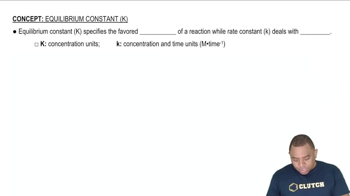
Equilibrium Constant (K)

The equilibrium constant (K) is a numerical value that expresses the ratio of the concentrations of products to reactants at equilibrium for a given chemical reaction. It is temperature-dependent and provides insight into the extent of a reaction; a large K indicates a reaction that favors products, while a small K suggests reactants are favored.
추천 영상:
가이드 코스
01:14
Equilibrium Constant K

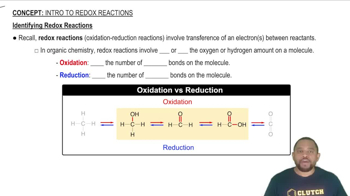
Redox Reactions

Redox (reduction-oxidation) reactions involve the transfer of electrons between species, resulting in changes in oxidation states. In the context of the given reaction, Fe2+ is reduced to Fe, while Zn is oxidized to Zn2+. Understanding the electron transfer is crucial for determining the direction and extent of the reaction.
추천 영상:
가이드 코스
03:12
Identifying Redox Reactions

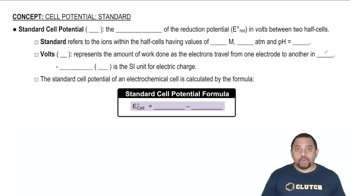
Standard Electrode Potentials

Standard electrode potentials are measured voltages that indicate the tendency of a species to be reduced or oxidized under standard conditions. These values can be used to calculate the overall cell potential for redox reactions, which in turn helps in determining the equilibrium constant using the Nernst equation.
추천 영상:
가이드 코스
01:27
Standard Cell Potential