Ch.19 - Electrochemistry
Tro - Chemistry: A Molecular Approach 4th Edition
Tro4th EditionChemistry: A Molecular ApproachISBN: 9780134112831당신이 사용하는 게 아니라요?교과서 변경
19장, 문제 90

Draw an electrolytic cell in which Mn2+ is reduced to Mn and Sn is oxidized to Sn2+. Label the anode and cathode, indicate the direction of electron flow, and write an equation for the half-reaction occurring at each electrode. What minimum voltage is necessary to drive the reaction?

검증된 단계별 안내
1
Step 1: Draw a container divided into two halves. In one half, place a Mn electrode immersed in a Mn2+ solution. In the other half, place a Sn electrode immersed in a Sn2+ solution. Connect the two electrodes with a wire and a battery. This is your basic setup for an electrolytic cell.
Step 2: Label the electrode where oxidation occurs as the anode. In this case, Sn is oxidized to Sn2+, so the Sn electrode is the anode. Write the half-reaction for this process: Sn -> Sn2+ + 2e-.
Step 3: Label the electrode where reduction occurs as the cathode. In this case, Mn2+ is reduced to Mn, so the Mn electrode is the cathode. Write the half-reaction for this process: Mn2+ + 2e- -> Mn.
Step 4: Indicate the direction of electron flow. In an electrolytic cell, electrons flow from the anode to the cathode through the wire. So, draw an arrow on the wire pointing from the Sn electrode to the Mn electrode.
Step 5: To find the minimum voltage necessary to drive the reaction, look up the standard reduction potentials for the two half-reactions. The voltage needed is the difference between the two potentials. Remember that in an electrolytic cell, the reaction is non-spontaneous, so the cell potential will be negative. The minimum voltage needed to drive the reaction is the absolute value of the cell potential.

비슷한 문제에 대한 검증된 영상 답변:

이 영상 해법은 위 문제에 도움이 된다고 튜터들이 추천한 것입니다.
영상 길이:
7m
도움이 되었나요?

주요 개념

질문에 올바르게 답하기 위해 반드시 이해해야 하는 핵심 개념들은 다음과 같습니다.

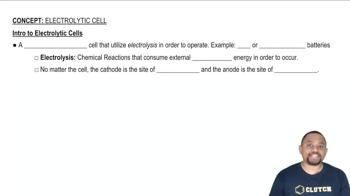
Electrolytic Cell

An electrolytic cell is a device that uses electrical energy to drive a non-spontaneous chemical reaction. It consists of two electrodes: the anode, where oxidation occurs, and the cathode, where reduction takes place. In this cell, an external power source provides the necessary voltage to facilitate the movement of electrons, allowing the desired chemical transformations to occur.
추천 영상:
가이드 코스
01:21
The Electrolytic Cell

Half-Reactions

Half-reactions represent the individual oxidation and reduction processes occurring in an electrochemical cell. In this context, the reduction half-reaction involves Mn2+ gaining electrons to form solid Mn, while the oxidation half-reaction involves Sn losing electrons to form Sn2+. Writing these half-reactions helps in understanding the electron transfer and balancing the overall redox reaction.
추천 영상:
가이드 코스
01:49
First-Order Half-Life

Minimum Voltage (Electrolysis)

The minimum voltage required to drive an electrolytic reaction is known as the cell potential or decomposition potential. This voltage must overcome the inherent energy barriers of the reactions occurring at the electrodes. It can be calculated using the standard reduction potentials of the half-reactions, and it is essential for ensuring that the desired redox processes occur efficiently in the electrolytic cell.
추천 영상:
가이드 코스
01:21
The Electrolytic Cell