Ch.19 - Electrochemistry
Tro - Chemistry: A Molecular Approach 4th Edition
Tro4th EditionChemistry: A Molecular ApproachISBN: 9780134112831당신이 사용하는 게 아니라요?교과서 변경
19장, 문제 85

Refer to the tabulated values of ∆Gf° in Appendix IIB to calculate E°cell for a fuel cell that employs the reaction between methane gas (CH4) and oxygen to form carbon dioxide and gaseous water.

검증된 단계별 안내
1
Identify the balanced chemical equation for the reaction: CH_4(g) + 2O_2(g) \(\rightarrow\) CO_2(g) + 2H_2O(g).
Use the standard Gibbs free energy of formation (∆G_f°) values from Appendix IIB for each species involved in the reaction: CH_4(g), O_2(g), CO_2(g), and H_2O(g).
Calculate the standard Gibbs free energy change (∆G°) for the reaction using the formula: ∆G° = Σ(∆G_f° of products) - Σ(∆G_f° of reactants).
Use the relationship between Gibbs free energy change and cell potential: ∆G° = -nFE°_cell, where n is the number of moles of electrons transferred and F is the Faraday constant.
Solve for the standard cell potential (E°_cell) using the equation: E°_cell = -∆G° / (nF).

주요 개념

질문에 올바르게 답하기 위해 반드시 이해해야 하는 핵심 개념들은 다음과 같습니다.

Gibbs Free Energy (∆Gf°)

Gibbs Free Energy (∆Gf°) is a thermodynamic potential that measures the maximum reversible work obtainable from a thermodynamic system at constant temperature and pressure. It is crucial for determining the spontaneity of a reaction; a negative ∆Gf° indicates that the reaction can occur spontaneously. In the context of fuel cells, the standard Gibbs free energy change can be used to calculate the cell potential.
추천 영상:
가이드 코스
01:51
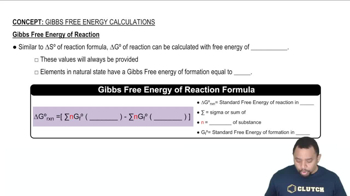
Gibbs Free Energy of Reactions

Electrochemical Cell Potential (E°cell)

The standard cell potential (E°cell) is the measure of the voltage produced by an electrochemical cell under standard conditions. It is calculated using the Nernst equation or derived from the Gibbs free energy change using the relationship E°cell = -∆G°/nF, where n is the number of moles of electrons transferred and F is Faraday's constant. Understanding this relationship is essential for evaluating the efficiency of fuel cells.
추천 영상:
가이드 코스
02:46
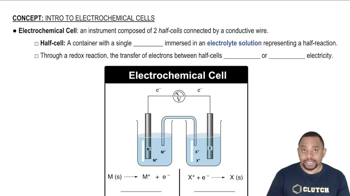
Electrochemical Cells

Redox Reactions

Redox reactions involve the transfer of electrons between two species, where one species is oxidized (loses electrons) and the other is reduced (gains electrons). In the context of the fuel cell reaction between methane and oxygen, identifying the oxidation states of carbon and oxygen is key to determining the half-reactions and calculating the overall cell potential. Mastery of redox concepts is fundamental for analyzing electrochemical systems.
추천 영상:
가이드 코스
03:12
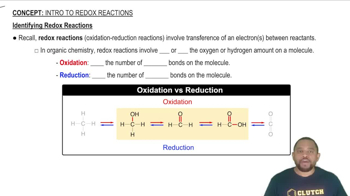
Identifying Redox Reactions