
Ch.19 - Electrochemistry
Tro - Chemistry: A Molecular Approach 4th Edition
Tro4th EditionChemistry: A Molecular ApproachISBN: 9780134112831당신이 사용하는 게 아니라요?교과서 변경
19장, 문제 114

What voltage can theoretically be achieved in a battery in which lithium metal is oxidized and fluorine gas is reduced, and why might such a battery be difficult to produce?

검증된 단계별 안내
1
Identify the half-reactions for the oxidation and reduction processes. For lithium, the oxidation half-reaction is: \( \text{Li} \rightarrow \text{Li}^+ + \text{e}^- \). For fluorine, the reduction half-reaction is: \( \text{F}_2 + 2\text{e}^- \rightarrow 2\text{F}^- \).
Look up the standard reduction potentials for each half-reaction. The standard reduction potential for \( \text{Li}^+ + \text{e}^- \rightarrow \text{Li} \) is approximately -3.04 V, and for \( \text{F}_2 + 2\text{e}^- \rightarrow 2\text{F}^- \) is approximately +2.87 V.
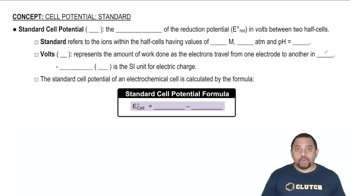
Calculate the standard cell potential (\( E^\circ_{\text{cell}} \)) by using the formula: \( E^\circ_{\text{cell}} = E^\circ_{\text{cathode}} - E^\circ_{\text{anode}} \). Substitute the values: \( E^\circ_{\text{cell}} = 2.87 \text{ V} - (-3.04 \text{ V}) \).
Discuss why such a battery might be difficult to produce. Consider factors like the reactivity of lithium metal, which is highly reactive and can pose safety risks, and the handling of fluorine gas, which is corrosive and toxic.
Conclude by considering the practical challenges in manufacturing and safely operating a battery with such reactive materials, despite the high theoretical voltage.

주요 개념

질문에 올바르게 답하기 위해 반드시 이해해야 하는 핵심 개념들은 다음과 같습니다.

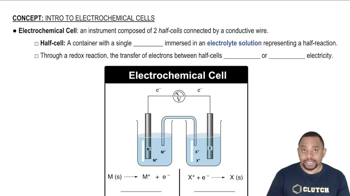
Electrochemical Cells

Electrochemical cells convert chemical energy into electrical energy through redox reactions. In a battery, oxidation occurs at the anode and reduction at the cathode. The voltage produced by a battery is determined by the difference in reduction potentials of the two half-reactions involved, which can be calculated using standard electrode potentials.
추천 영상:
가이드 코스
02:46
Electrochemical Cells

Standard Electrode Potentials

Standard electrode potentials are measured under standard conditions and indicate the tendency of a species to be reduced. The more positive the potential, the greater the species' ability to gain electrons. For lithium and fluorine, lithium has a very negative standard reduction potential, while fluorine has a very positive one, leading to a high theoretical voltage when combined in a battery.
추천 영상:
가이드 코스
01:27
Standard Cell Potential

Practical Challenges in Battery Production

While the theoretical voltage of a lithium-fluorine battery is high, practical challenges arise in its production. Lithium is highly reactive, and fluorine is extremely corrosive and toxic, making safe handling and containment difficult. Additionally, the formation of lithium fluoride during the reaction can hinder the battery's performance and longevity, complicating the design of a viable battery.
추천 영상:
가이드 코스
01:30
Production of Hydrogen Example
관련 실천
교과서 질문

A battery relies on the oxidation of magnesium and the reduction of Cu2+. The initial concentrations of Mg2+ and Cu2+ are 1.0 × 10⁻⁴ M and 1.5 M, respectively, in 1.0-liter half-cells. b. What is the voltage of the battery after delivering 5.0 A for 8.0 h?

414
views
1
rank
교과서 질문

A friend wants you to invest in a new battery she has designed that produces 24 V in a single voltaic cell. Why should you be wary of investing in such a battery?

294
views
교과서 질문

A battery relies on the oxidation of magnesium and the reduction of Cu2+. The initial concentrations of Mg2+ and Cu2+ are 1.0 × 10⁻⁴ M and 1.5 M, respectively, in 1.0-liter half-cells. a. What is the initial voltage of the battery?

1435
views
교과서 질문

A battery relies on the oxidation of magnesium and the reduction of Cu2+. The initial concentrations of Mg2+ and Cu2+ are 1.0 × 10⁻⁴ M and 1.5 M, respectively, in 1.0-liter half-cells. c. How long can the battery deliver 5.0 A before going dead?

799
views
1
rank
1
comments
교과서 질문

The cell potential of this electrochemical cell depends on the gold concentration in the cathode half-cell. Pt(s) | H2(g, 1.0 atm) | H+(aq, 1.0 M) || Au3+(aq, ? M) | Au(s) What is the concentration of Au3+ in the solution if Ecell is 1.22 V?

2237
views
교과서 질문

The cell potential of this electrochemical cell depends on the pH of the solution in the anode half-cell. Pt(s) | H2(g, 1 atm) | H+(aq, ? M) || Cu2+(aq, 1.0 M) | Cu(s) What is the pH of the solution if Ecell is 355 mV?

2744
views
1
rank