What is the edge length (in cm) of a titanium cube that contains 2.55 * 1024 titanium atoms? The density of titanium is 4.50 g/cm3.
Ch.2 - Atoms & Elements
2장, 문제 116
Boron has only two naturally occurring isotopes. The mass of boron-10 is 10.01294 amu and the mass of boron-11 is 11.00931 amu. Calculate the relative abundances of the two isotopes.
검증된 단계별 안내1
Let the abundance of boron-10 be represented as x. Since there are only two isotopes, the abundance of boron-11 will be 1 - x.
Set up the equation for the average atomic mass of boron using the given isotopic masses and the variable x for the abundances. The equation will be: (10.01294 amu * x) + (11.00931 amu * (1 - x)) = average atomic mass of boron.
Find the average atomic mass of boron from the periodic table, which is typically around 10.81 amu.
Substitute the average atomic mass of boron into the equation from step 2 and solve for x.
Once x is found, calculate 1 - x to find the abundance of boron-11. The values of x and 1 - x will give the relative abundances of boron-10 and boron-11, respectively.

비슷한 문제에 대한 검증된 영상 답변:
이 영상 해법은 위 문제에 도움이 된다고 튜터들이 추천한 것입니다.
도움이 되었나요?
주요 개념
질문에 올바르게 답하기 위해 반드시 이해해야 하는 핵심 개념들은 다음과 같습니다.
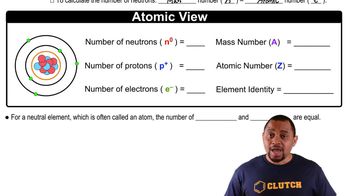
Isotopes
Isotopes are variants of a chemical element that have the same number of protons but different numbers of neutrons, resulting in different atomic masses. For example, boron has two isotopes, boron-10 and boron-11, which differ in their neutron count. Understanding isotopes is crucial for calculations involving relative abundances and average atomic mass.
추천 영상:
가이드 코스
Isotopes
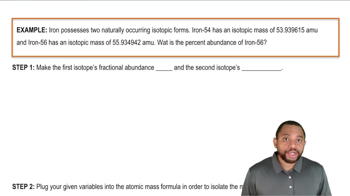
Relative Abundance
Relative abundance refers to the proportion of each isotope of an element present in a natural sample. It is typically expressed as a percentage or fraction of the total amount of the element. To calculate relative abundances, one can use the weighted average of the isotopes' masses and their respective contributions to the overall atomic mass of the element.
추천 영상:
가이드 코스
Calculating Abundance Example
Weighted Average
A weighted average is a mean that takes into account the varying degrees of importance of the numbers in a data set. In the context of isotopes, the weighted average of the isotopes' masses is calculated using their relative abundances. This concept is essential for determining the average atomic mass of an element based on its isotopes and their respective contributions.
추천 영상:
가이드 코스
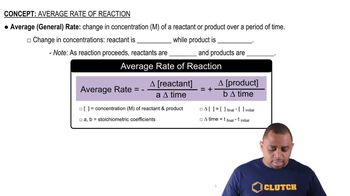
Average Rate of Reaction
관련 실천
교과서 질문
1235
views
1
rank
교과서 질문
A pure copper sphere has a radius of 0.935 in. How many copper atoms does it contain? [The volume of a sphere is (4/3)πr3 and the density of copper is 8.96 g/cm3.]
1528
views
교과서 질문
A 67.2 g sample of a gold and palladium alloy contains 2.49×10²³ atoms. What is the composition (by mass) of the alloy?
2077
views
4
rank
1
comments
교과서 질문
Lithium has only two naturally occurring isotopes. The mass of lithium-6 is 6.01512 amu and the mass of lithium-7 is 7.01601 amu. Calculate the relative abundances of the two isotopes.
8887
views
교과서 질문
Common brass is a copper and zinc alloy containing 37.0% zinc by mass and having a density of 8.48 g/cm3. A fitting composed of common brass has a total volume of 112.5 cm3. How many atoms (copper and zinc) does the fitting contain?
2131
views
1
rank