
Carbon-12 contains six protons and six neutrons. The radius of the nucleus is approximately 2.7 fm (femtometers) and the radius of the atom is approximately 70 pm (picometers). Calculate the volume of the nucleus and the volume of the atom.
Ch.2 - Atoms & Elements
2장, 문제 106
Neutron stars are composed of solid nuclear matter, primarily neutrons. Assume the radius of a neutron is approximately 1.0×10⁻¹³ cm. Calculate the density of a neutron. [Hint: For a sphere V = (4/3)πr3.] Assuming that a neutron star has the same density as a neutron, calculate the mass (in kg) of a small piece of a neutron star the size of a spherical pebble with a radius of 0.10 mm.
검증된 단계별 안내1
Calculate the volume of a neutron using the formula for the volume of a sphere: \(V = \frac{4}{3}\pi r^3\), where \(r\) is the radius of the neutron.
Substitute the given radius of the neutron, \(1.0 \times 10^{-13}\) cm, into the volume formula to find the volume of a neutron.
Use the mass of a neutron, approximately \(1.675 \times 10^{-24}\) g, to calculate the density of a neutron using the formula: \(\text{Density} = \frac{\text{Mass}}{\text{Volume}}\).
Convert the radius of the pebble from millimeters to centimeters (0.10 mm = 0.010 cm) and calculate the volume of the pebble using the sphere volume formula: \(V = \frac{4}{3}\pi r^3\).
Multiply the volume of the pebble by the density of a neutron to find the mass of the pebble in grams, and then convert the mass to kilograms.

비슷한 문제에 대한 검증된 영상 답변:
이 영상 해법은 위 문제에 도움이 된다고 튜터들이 추천한 것입니다.
영상 길이:
3m도움이 되었나요?
주요 개념
질문에 올바르게 답하기 위해 반드시 이해해야 하는 핵심 개념들은 다음과 같습니다.
Density
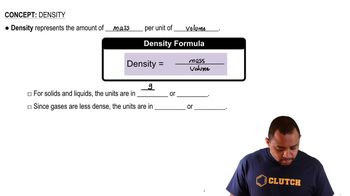
Density is defined as mass per unit volume, typically expressed in grams per cubic centimeter (g/cm³) or kilograms per cubic meter (kg/m³). It is a crucial property that helps determine how much matter is packed into a given space. In this context, understanding density allows us to calculate the mass of a neutron based on its volume and the relationship between mass and density.
추천 영상:
가이드 코스
Density Concepts
Volume of a Sphere
The volume of a sphere is calculated using the formula V = (4/3)πr³, where r is the radius of the sphere. This formula is essential for determining the volume of both a neutron and a small piece of a neutron star, as it allows us to quantify the space occupied by these spherical objects. Accurate volume calculations are necessary to find the corresponding mass when density is known.
추천 영상:
가이드 코스
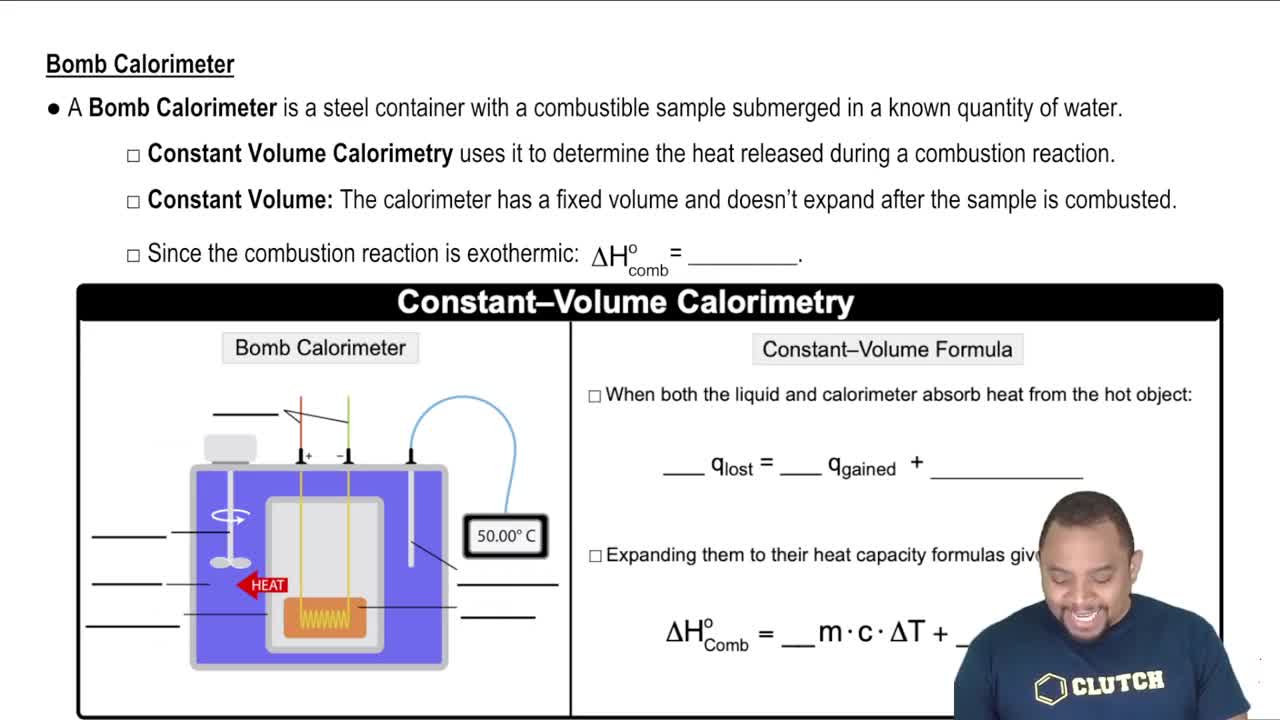
Constant-Volume Calorimetry
Mass Calculation
Mass can be calculated using the formula mass = density × volume. This relationship is fundamental in physics and chemistry, as it connects the amount of matter (mass) to how densely it is packed (density) and the space it occupies (volume). In the context of the question, this formula will be used to find the mass of a neutron star fragment by applying the density of a neutron to the calculated volume of the pebble-sized sphere.
추천 영상:
가이드 코스
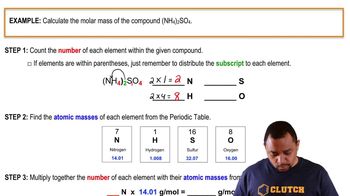
Molar Mass Calculation Example
관련 실천
교과서 질문
1537
views
교과서 질문
Carbon-12 contains six protons and six neutrons. The radius of the nucleus is approximately 2.7 fm (femtometers) and the radius of the atom is approximately 70 pm (picometers). What percentage of the carbon atom's volume is occupied by the nucleus? (Assume two significant figures.)
1549
views
2
rank
교과서 질문
A penny has a thickness of approximately 1.0 mm. If you stacked Avogadro's number of pennies one on top of the other on Earth's surface, how far would the stack extend (in km)? [For comparison, the sun is about 150 million km from Earth and the nearest star (Proxima Centauri) is about 40 trillion km from Earth.]
1499
views
교과서 질문
Nuclei with the same number of neutrons but different mass numbers are called isotones. Write the symbols of four isotones of 236Th.
1591
views
