
Silicon has three naturally occurring isotopes (Si-28, Si-29, and Si-30). The mass and natural abundance of Si-28 are 27.9769 amu and 92.2%, respectively. The mass and natural abundance of Si-29 are 28.9765 amu and 4.67%, respectively. Find the mass and natural abundance of Si-30.
Ch.2 - Atoms & Elements
2장, 문제 80
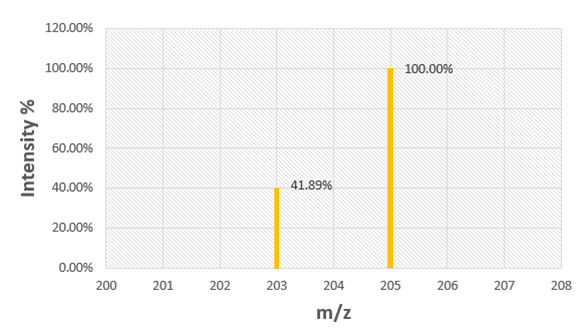
Use the mass spectrum of rubidium to determine the atomic mass of rubidium.

검증된 단계별 안내1
Identify the isotopes of rubidium from the mass spectrum. The m/z values are 203 and 205.
Note the relative intensities of each isotope. For m/z 203, the intensity is 41.89%, and for m/z 205, the intensity is 100%.
Convert the relative intensities to fractional abundances. For m/z 203, the fractional abundance is 41.89 / (41.89 + 100). For m/z 205, the fractional abundance is 100 / (41.89 + 100).
Calculate the weighted average atomic mass of rubidium using the formula: (fractional abundance of isotope 1 * mass of isotope 1) + (fractional abundance of isotope 2 * mass of isotope 2).
Substitute the values into the formula and solve for the atomic mass of rubidium.

비슷한 문제에 대한 검증된 영상 답변:
이 영상 해법은 위 문제에 도움이 된다고 튜터들이 추천한 것입니다.
영상 길이:
3m도움이 되었나요?
주요 개념
질문에 올바르게 답하기 위해 반드시 이해해야 하는 핵심 개념들은 다음과 같습니다.
Mass Spectrum
A mass spectrum is a graphical representation of the mass-to-charge ratio (m/z) of ions. It displays the relative abundance of each ion detected, allowing chemists to identify the composition of a sample. Peaks in the spectrum correspond to different isotopes or molecular fragments, with their heights indicating the intensity or abundance of each ion.
추천 영상:
가이드 코스
Electromagnetic Spectrum
Atomic Mass
Atomic mass is the weighted average mass of an element's isotopes, measured in atomic mass units (amu). It reflects both the mass and the relative abundance of each isotope present in a sample. To calculate the atomic mass from a mass spectrum, one must consider the m/z values and their corresponding intensity percentages to find a weighted average.
추천 영상:
가이드 코스
Atomic Mass
Isotopes
Isotopes are variants of a chemical element that have the same number of protons but different numbers of neutrons, resulting in different atomic masses. For rubidium, the isotopes present in the mass spectrum are typically Rb-203, Rb-204, and Rb-205. Understanding isotopes is crucial for accurately determining the atomic mass from the mass spectrum, as each isotope contributes differently based on its abundance.
추천 영상:
가이드 코스
Isotopes
관련 실천
교과서 질문
9413
views
교과서 질문
How many sulfur atoms are there in 5.52 mol of sulfur?
1811
views
1
rank
교과서 질문
How many moles of aluminum do 3.7×1024 aluminum atoms represent?
912
views
교과서 질문
Use the mass spectrum of europium to determine the atomic mass of europium.
686
views
교과서 질문
What is the amount, in moles, of each elemental sample? a. 11.8 g Ar b. 3.55 g Zn c. 26.1 g Ta d. 0.211 g Li
617
views
교과서 질문
Bromine has two naturally occurring isotopes (Br-79 and Br-81) and has an atomic mass of 79.904 amu. The mass of Br-81 is 80.9163 amu, and its natural abundance is 49.31%. Calculate the mass and natural abundance of Br-79.
8889
views
3
rank
1
comments
