Ch.20 - Radioactivity and Nuclear Chemistry
Tro - Chemistry: A Molecular Approach 4th Edition
Tro4th EditionChemistry: A Molecular ApproachISBN: 9780134112831당신이 사용하는 게 아니라요?교과서 변경
20장, 문제 81

Bismuth-210 is a beta emitter with a half-life of 5.0 days. If a sample contains 1.2 g of Bi-210 (atomic mass = 209.984105 amu), how many beta emissions occur in 13.5 days? If a person’s body intercepts 5.5% of those emissions, what amount of radiation (in Ci) is the person exposed to?

검증된 단계별 안내
1
Calculate the number of half-lives that have passed in 13.5 days by dividing the total time by the half-life of Bi-210.
Use the number of half-lives to determine the remaining mass of Bi-210 using the formula: \( \text{Remaining mass} = \text{Initial mass} \times \left( \frac{1}{2} \right)^{\text{number of half-lives}} \).
Calculate the decayed mass of Bi-210 by subtracting the remaining mass from the initial mass.
Convert the decayed mass of Bi-210 to moles using its atomic mass (209.984105 amu).
Calculate the total number of beta emissions by multiplying the moles of decayed Bi-210 by Avogadro's number (\(6.022 \times 10^{23}\) atoms/mol) and then by the percentage of emissions intercepted (5.5%).

주요 개념

질문에 올바르게 답하기 위해 반드시 이해해야 하는 핵심 개념들은 다음과 같습니다.

Half-life

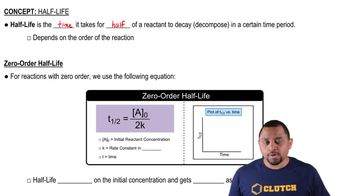
Half-life is the time required for half of the radioactive nuclei in a sample to decay. For Bismuth-210, with a half-life of 5.0 days, this means that after 5 days, half of the original amount will have decayed. Understanding half-life is crucial for calculating the remaining quantity of a radioactive substance over time and predicting the number of decay events that will occur.
추천 영상:
가이드 코스
02:17
Zero-Order Half-life

Beta decay

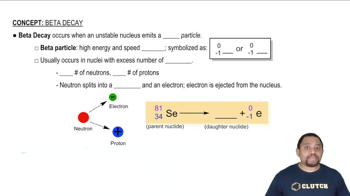
Beta decay is a type of radioactive decay in which a beta particle (an electron or positron) is emitted from an atomic nucleus. In the case of Bismuth-210, it undergoes beta decay, transforming into a different element while releasing energy. This process is essential for determining the number of emissions that occur over a specified time period, as each decay event corresponds to one beta emission.
추천 영상:

Radioactivity and exposure measurement

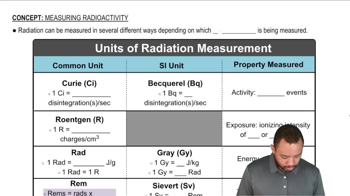
Radioactivity refers to the process by which unstable atomic nuclei lose energy by emitting radiation. The exposure to radiation can be quantified in curies (Ci), a unit that measures the activity of a radioactive source. To calculate the exposure a person receives from beta emissions, one must consider the total emissions and the percentage intercepted, allowing for an assessment of potential health risks associated with radiation exposure.
추천 영상:
가이드 코스
02:52
Units of Radiation Measurement