Ch.20 - Radioactivity and Nuclear Chemistry
Tro - Chemistry: A Molecular Approach 4th Edition
Tro4th EditionChemistry: A Molecular ApproachISBN: 9780134112831당신이 사용하는 게 아니라요?교과서 변경
20장, 문제 71

Calculate the quantity of energy produced per gram of reactant for the fusion of two H-2 (atomic mass = 2.014102 amu) atoms to form He-3 (atomic mass = 3.016029 amu) and one neutron.

검증된 단계별 안내
1
Identify the nuclear reaction: \( ^2_1\text{H} + ^2_1\text{H} \rightarrow ^3_2\text{He} + ^1_0\text{n} \).
Calculate the mass defect by finding the difference between the total mass of reactants and the total mass of products.
Convert the mass defect from atomic mass units (amu) to energy using Einstein's equation \( E = \Delta m c^2 \), where \( c \) is the speed of light.
Determine the energy produced per mole of reactants by multiplying the energy per reaction by Avogadro's number.
Calculate the energy produced per gram of reactant by dividing the energy per mole by the molar mass of the reactants.

주요 개념

질문에 올바르게 답하기 위해 반드시 이해해야 하는 핵심 개념들은 다음과 같습니다.

Nuclear Fusion

Nuclear fusion is the process where two light atomic nuclei combine to form a heavier nucleus, releasing energy in the process. This reaction is the source of energy for stars, including the sun, and occurs under extreme temperature and pressure conditions. In the given question, the fusion of deuterium (H-2) atoms to form helium-3 and a neutron exemplifies this process.
추천 영상:
가이드 코스
02:06
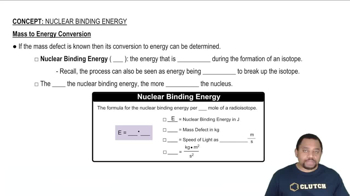
Nuclear Binding Energy

Mass-Energy Equivalence

Mass-energy equivalence, encapsulated in Einstein's equation E=mc², states that mass can be converted into energy and vice versa. In nuclear reactions, the mass of the products is often less than the mass of the reactants, and this 'missing' mass is converted into energy. This principle is crucial for calculating the energy produced in the fusion reaction described in the question.
추천 영상:
가이드 코스
04:12
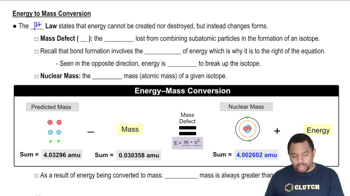
Energy to Mass Conversion

Energy Calculation in Nuclear Reactions

To calculate the energy produced in a nuclear reaction, one must determine the mass defect, which is the difference between the mass of the reactants and the mass of the products. This mass defect is then converted into energy using the mass-energy equivalence principle. In the context of the question, this involves calculating the mass of the two H-2 atoms, the He-3 atom, and the neutron to find the energy released per gram of reactant.
추천 영상:
가이드 코스
02:06
Nuclear Binding Energy