Ch.20 - Radioactivity and Nuclear Chemistry
Tro - Chemistry: A Molecular Approach 4th Edition
Tro4th EditionChemistry: A Molecular ApproachISBN: 9780134112831당신이 사용하는 게 아니라요?교과서 변경
20장, 문제 78a

Complete each nuclear equation and calculate the energy change (in J/mol of reactant) associated with each (Al-27 = 26.981538 amu, Am-241 = 241.056822 amu, He-4 = 4.002603 amu, Np-237 = 237.048166 amu, P-30 = 29.981801 amu, S-32 = 31.972071 amu, and Si-29 = 28.976495 amu).
a. 2713Al + 42He → 3015P + ____

검증된 단계별 안내
1
Identify the missing product in the nuclear reaction. The sum of atomic numbers and mass numbers must be conserved. For the given reaction, \( ^{27}_{13}\text{Al} + ^{4}_{2}\text{He} \rightarrow ^{30}_{15}\text{P} + X \), solve for X.
Calculate the atomic number and mass number of the missing product. The atomic number should be \( 13 + 2 - 15 = 0 \) and the mass number should be \( 27 + 4 - 30 = 1 \). Therefore, the missing product is a neutron \( ^{1}_{0}\text{n} \).
Write the complete nuclear equation: \( ^{27}_{13}\text{Al} + ^{4}_{2}\text{He} \rightarrow ^{30}_{15}\text{P} + ^{1}_{0}\text{n} \).
Calculate the mass defect by finding the difference in mass between the reactants and products. Use the given atomic masses: \( \Delta m = (26.981538 + 4.002603) - (29.981801 + 1.008665) \) amu.
Convert the mass defect from amu to energy using Einstein's equation \( E = \Delta m \times c^2 \), where \( c \) is the speed of light \( 3.00 \times 10^8 \text{ m/s} \). Then, convert the energy from J to J/mol by multiplying by Avogadro's number \( 6.022 \times 10^{23} \text{ mol}^{-1} \).

비슷한 문제에 대한 검증된 영상 답변:

이 영상 해법은 위 문제에 도움이 된다고 튜터들이 추천한 것입니다.
영상 길이:
6m
도움이 되었나요?

주요 개념

질문에 올바르게 답하기 위해 반드시 이해해야 하는 핵심 개념들은 다음과 같습니다.

Nuclear Reactions

Nuclear reactions involve changes in an atom's nucleus and can result in the transformation of one element into another. These reactions are characterized by the conservation of mass and energy, where the total mass and energy before and after the reaction remain constant. Understanding the types of nuclear reactions, such as alpha decay, beta decay, and fusion, is essential for completing nuclear equations.
추천 영상:
가이드 코스
02:06
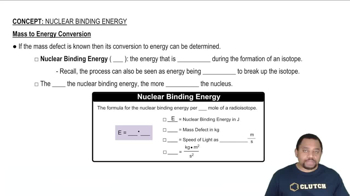
Nuclear Binding Energy

Mass-Energy Equivalence

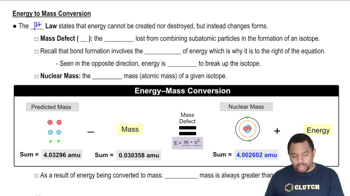
Mass-energy equivalence, expressed by Einstein's equation E=mc², indicates that mass can be converted into energy and vice versa. In nuclear reactions, a small amount of mass is often lost and converted into energy, which can be calculated to determine the energy change associated with the reaction. This concept is crucial for calculating the energy change in nuclear equations.
추천 영상:
가이드 코스
04:12
Energy to Mass Conversion

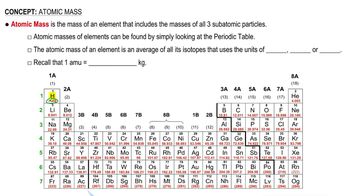
Atomic Mass Units (amu)

Atomic mass units (amu) are a standard unit of mass used to express atomic and molecular weights. The mass of an atom is often measured in amu, where 1 amu is defined as one twelfth of the mass of a carbon-12 atom. In nuclear equations, knowing the atomic masses of the reactants and products is vital for balancing the equation and calculating the energy change.
추천 영상: