Ch.20 - Radioactivity and Nuclear Chemistry
Tro - Chemistry: A Molecular Approach 4th Edition
Tro4th EditionChemistry: A Molecular ApproachISBN: 9780134112831당신이 사용하는 게 아니라요?교과서 변경
20장, 문제 83

Radium-226 (atomic mass = 226.025402 amu) decays to radon-222 (a radioactive gas) with a half-life of 1.6⨉103 years. What volume of radon gas (at 25.0 °C and 1.0 atm) does 25.0 g of radium produce in 5.0 days? (Report your answer to two significant digits.)

검증된 단계별 안내
1
Convert the mass of radium-226 to moles using its atomic mass: \( \text{moles of } \text{Ra} = \frac{25.0 \text{ g}}{226.025402 \text{ amu}} \).
Determine the fraction of radium that decays in 5.0 days using the half-life formula: \( N_t = N_0 \left( \frac{1}{2} \right)^{\frac{t}{t_{1/2}}} \), where \( t = 5.0 \text{ days} \) and \( t_{1/2} = 1.6 \times 10^3 \text{ years} \).
Calculate the moles of radon-222 produced, which is equal to the moles of radium-226 that decayed.
Use the ideal gas law \( PV = nRT \) to find the volume of radon gas, where \( P = 1.0 \text{ atm} \), \( R = 0.0821 \text{ L atm K}^{-1} \text{ mol}^{-1} \), and \( T = 25.0 \degree C = 298.15 \text{ K} \).
Solve for \( V \) in the ideal gas law equation to find the volume of radon gas produced.

주요 개념

질문에 올바르게 답하기 위해 반드시 이해해야 하는 핵심 개념들은 다음과 같습니다.

Radioactive Decay and Half-Life

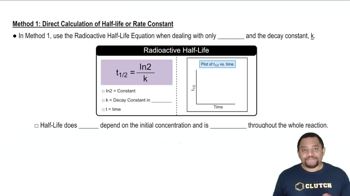
Radioactive decay is the process by which an unstable atomic nucleus loses energy by emitting radiation. The half-life is the time required for half of the radioactive atoms in a sample to decay. For Radium-226, with a half-life of 1.6 × 10^3 years, this means that after this period, half of the original amount will have transformed into Radon-222.
추천 영상:
가이드 코스
01:49
Method 1 of Radioactive Half-Life

Ideal Gas Law

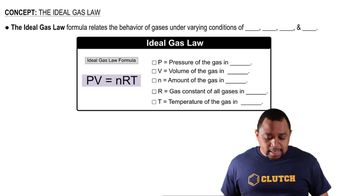
The Ideal Gas Law relates the pressure, volume, temperature, and number of moles of a gas through the equation PV = nRT. Here, P is pressure, V is volume, n is the number of moles, R is the ideal gas constant, and T is temperature in Kelvin. This law is essential for calculating the volume of gas produced from the decay of Radium-226 into Radon-222 under specified conditions.
추천 영상:
가이드 코스
01:15
Ideal Gas Law Formula

Stoichiometry of Radioactive Decay

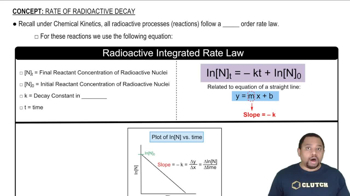
Stoichiometry in the context of radioactive decay involves calculating the amount of product formed from a given amount of reactant based on the decay process. In this case, knowing the initial mass of Radium-226 allows us to determine how much Radon-222 is produced after a certain time, using the decay constant derived from the half-life.
추천 영상:
가이드 코스
03:00
Rate of Radioactive Decay