Ch.20 - Radioactivity and Nuclear Chemistry

Tro4th EditionChemistry: A Molecular ApproachISBN: 9780134112831
당신이 사용하는 게 아니라요?교과서 변경다른 교과서를 선택하세요
TOC.tableOfContents
- Ch.1 - Matter, Measurement & Problem Solving136
- Ch.2 - Atoms & Elements112
- Ch.3 - Molecules, Compounds & Chemical Equations159
- Ch.4 - Chemical Quantities & Aqueous Reactions140
- Ch.5 - Gases118
- Ch.6 - Thermochemistry106
- Ch.7 - Quantum-Mechanical Model of the Atom62
- Ch.8 - Periodic Properties of the Elements103
- Ch.9 - Chemical Bonding I: The Lewis Model104
- Ch.10 - Chemical Bonding II: Molecular Shapes & Valence Bond Theory89
- Ch.11 - Liquids, Solids & Intermolecular Forces73
- Ch.12 - Solids and Modern Material59
- Ch.13 - Solutions110
- Ch.14 - Chemical Kinetics140
- Ch.15 - Chemical Equilibrium78
- Ch.16 - Acids and Bases155
- Ch.17 - Aqueous Ionic Equilibrium176
- Ch.18 - Free Energy and Thermodynamics108
- Ch.19 - Electrochemistry118
- Ch.20 - Radioactivity and Nuclear Chemistry82
- Ch.21 - Organic Chemistry150

20장, 문제 98
The nuclide 18F decays by both electron capture and β+ decay. Find the difference in the energy released by these two processes. The atomic masses are 18F = 18.000950 and 18O = 17.9991598.
 검증된 단계별 안내
1
Identify the two decay processes: electron capture and beta-plus (β+) decay.
For electron capture, calculate the energy released using the mass difference between the parent nuclide (18F) and the daughter nuclide (18O).
For β+ decay, calculate the energy released by considering the mass difference between the parent nuclide (18F) and the daughter nuclide (18O), and account for the mass of the emitted positron.
Use the equation E = Δm * c^2 to convert the mass difference to energy, where Δm is the mass difference and c is the speed of light.
Find the difference in energy released between the two processes by subtracting the energy calculated for electron capture from the energy calculated for β+ decay.
비슷한 문제에 대한 검증된 영상 답변:
이 영상 해법은 위 문제에 도움이 된다고 튜터들이 추천한 것입니다.

영상 길이:
6m주요 개념
질문에 올바르게 답하기 위해 반드시 이해해야 하는 핵심 개념들은 다음과 같습니다.
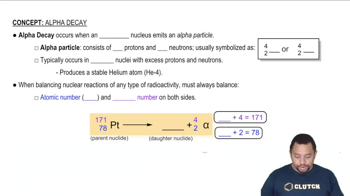
Nuclear Decay Processes
Nuclear decay processes, such as electron capture and beta-plus (β+) decay, involve the transformation of unstable nuclei into more stable forms. In electron capture, an electron is absorbed by a proton, converting it into a neutron and emitting a neutrino. In β+ decay, a proton is transformed into a neutron, emitting a positron and a neutrino. Understanding these processes is crucial for analyzing the energy changes associated with nuclear reactions.
추천 영상:
가이드 코스
 03:53
03:53
Alpha Decay
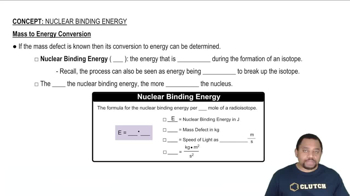
Energy Release in Nuclear Reactions
The energy released during nuclear reactions is determined by the mass difference between the reactants and products, as described by Einstein's equation E=mc². When a nuclide undergoes decay, the mass of the resulting particles is often less than that of the original nuclide, and this mass defect is converted into energy. Calculating the energy released in different decay processes allows for a comparison of their efficiencies and impacts.
추천 영상:
가이드 코스
 02:06
02:06Nuclear Binding Energy
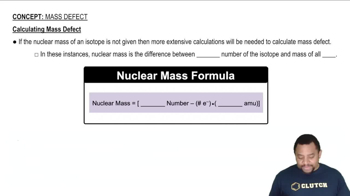
Atomic Mass and Mass Defect
Atomic mass is a measure of the mass of an atom, typically expressed in atomic mass units (amu). The mass defect refers to the difference between the total mass of the individual nucleons and the actual mass of the nucleus, which accounts for the binding energy that holds the nucleus together. In decay calculations, knowing the atomic masses of the involved nuclides is essential for determining the mass defect and, consequently, the energy released during the decay.
추천 영상:
가이드 코스
 00:55
00:55Calculating Mass Defect
관련 실천