Ch.20 - Radioactivity and Nuclear Chemistry
Tro - Chemistry: A Molecular Approach 4th Edition
Tro4th EditionChemistry: A Molecular ApproachISBN: 9780134112831당신이 사용하는 게 아니라요?교과서 변경
20장, 문제 85

When a positron and an electron annihilate one another, the resulting mass is completely converted to energy. Calculate the energy associated with this process in kJ/mol.

검증된 단계별 안내
1
Identify the particles involved: a positron and an electron, each with a mass of approximately 9.109 x 10^{-31} kg.
Use Einstein's mass-energy equivalence formula, E=mc^2, to calculate the energy released when one electron and one positron annihilate. Here, m is the combined mass of the electron and positron, and c is the speed of light (approximately 3.00 x 10^8 m/s).
Calculate the energy for one pair of electron and positron in joules.
Convert the energy from joules to kilojoules by dividing by 1000.
To find the energy per mole, multiply the energy per pair by Avogadro's number (6.022 x 10^{23} mol^{-1}).

주요 개념

질문에 올바르게 답하기 위해 반드시 이해해야 하는 핵심 개념들은 다음과 같습니다.

Mass-Energy Equivalence

Mass-energy equivalence, expressed by Einstein's equation E=mc², states that mass can be converted into energy and vice versa. In the context of particle annihilation, the mass of the electron and positron is transformed into energy, illustrating the profound relationship between mass and energy in physics.
추천 영상:
가이드 코스
04:12
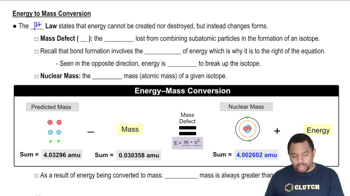
Energy to Mass Conversion

Annihilation Reaction

Annihilation occurs when a particle and its antiparticle collide, resulting in their mutual destruction and the release of energy. In this case, when an electron meets a positron, they annihilate each other, producing gamma-ray photons, which carry away the energy equivalent to the mass of the particles involved.
추천 영상:
가이드 코스
01:30
Alcohol Reactions: Dehydration Reactions

Energy Conversion to kJ/mol

To calculate energy in kJ/mol, one must first determine the energy released from the annihilation of a single electron-positron pair and then convert this energy to a per-mole basis. This involves using Avogadro's number (6.022 x 10²³) to scale the energy from a single reaction to the amount in one mole of particles, facilitating comparisons in chemical reactions.
추천 영상:
가이드 코스
01:56
Conversion Factors