Ch.21 - Organic Chemistry
Tro - Chemistry: A Molecular Approach 4th Edition
Tro4th EditionChemistry: A Molecular ApproachISBN: 9780134112831당신이 사용하는 게 아니라요?교과서 변경
21장, 문제 78

Determine the product of the addition reaction.
Chemical structure showing an addition reaction of an aldehyde with HCN to form a product.

검증된 단계별 안내
1
Identify the functional groups involved in the reaction. Here, we have an aldehyde group (C=O) and hydrogen cyanide (HCN).
Understand the mechanism of the addition reaction. HCN will add across the carbon-oxygen double bond of the aldehyde.
The carbon in the aldehyde group is electrophilic, and the cyanide ion (CN-) from HCN is nucleophilic. The nucleophilic CN- will attack the electrophilic carbon of the carbonyl group.
This attack will result in the formation of a tetrahedral intermediate where the carbonyl carbon now has an additional bond to the CN group and an OH group (from the protonation of the oxygen).
The final product will be a cyanohydrin, where the original carbonyl carbon is now bonded to an OH group and a CN group.

비슷한 문제에 대한 검증된 영상 답변:

이 영상 해법은 위 문제에 도움이 된다고 튜터들이 추천한 것입니다.
영상 길이:
1m

주요 개념

질문에 올바르게 답하기 위해 반드시 이해해야 하는 핵심 개념들은 다음과 같습니다.

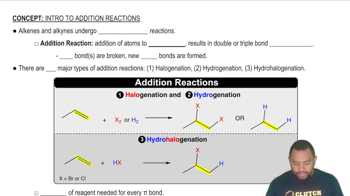
Addition Reactions

Addition reactions involve the combination of two or more reactants to form a single product. In organic chemistry, these reactions often occur with unsaturated compounds, such as alkenes and alkynes, where π bonds are broken to allow new σ bonds to form. The reaction typically results in the saturation of the molecule, increasing the number of single bonds.
추천 영상:
가이드 코스
02:55
Addition Reactions

Aldehydes and Their Reactivity

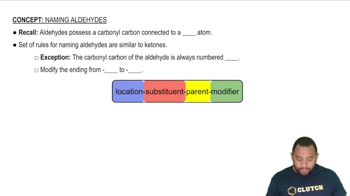
Aldehydes are organic compounds characterized by the presence of a carbonyl group (C=O) at the end of a carbon chain. They are highly reactive due to the electrophilic nature of the carbonyl carbon, making them susceptible to nucleophilic attack. In the presence of nucleophiles, such as HCN, aldehydes can undergo addition reactions to form new products, often resulting in the formation of cyanohydrins.
추천 영상:
가이드 코스
00:54
Rules for Naming Aldehydes

Nucleophilic Addition

Nucleophilic addition is a fundamental reaction mechanism in organic chemistry where a nucleophile attacks an electrophilic center, typically a carbon atom in a carbonyl group. This process leads to the formation of a new bond and often results in the conversion of a carbonyl compound into an alcohol or other functional groups. In the case of the reaction with HCN, the cyanide ion acts as the nucleophile, adding to the carbonyl carbon of the aldehyde.
추천 영상:
가이드 코스
02:55
Addition Reactions