Ch.21 - Organic Chemistry
Tro - Chemistry: A Molecular Approach 4th Edition
Tro4th EditionChemistry: A Molecular ApproachISBN: 9780134112831당신이 사용하는 게 아니라요?교과서 변경
21장, 문제 100

Identify the two compounds that display stereoisomerism and draw their structures. a. 3-methyl-3-pentanol b. 2-methyl-2-pentanol c. 3-methyl-2-pentanol d. 2-methyl-3-pentanol e. 2,4-dimethyl-3-pentanol

검증된 단계별 안내
1
Identify the main carbon chain and the functional groups in the compound 2,4-dimethyl-3-pentanol. The main chain consists of five carbon atoms (pentanol), with an OH group (alcohol) attached to the third carbon.
Identify the positions of the methyl groups according to the name. There are methyl groups attached to the second and fourth carbons of the main chain.
Determine the chirality of the carbon atoms. A carbon atom is chiral if it is attached to four different groups. In this molecule, the third carbon (where the OH group is attached) is bonded to a hydrogen, a methyl group, the rest of the carbon chain on one side, and the rest of the carbon chain including a methyl group on the other side, making it a chiral center.
Draw the structure of 2,4-dimethyl-3-pentanol showing the chiral center at the third carbon. Use wedge and dash bonds to indicate the three-dimensional arrangement of the groups around the chiral center.
Identify the stereoisomers, which are the two different spatial arrangements (R and S configurations) of the groups around the chiral center. These configurations can be determined using the Cahn-Ingold-Prelog priority rules.

비슷한 문제에 대한 검증된 영상 답변:

이 영상 해법은 위 문제에 도움이 된다고 튜터들이 추천한 것입니다.
영상 길이:
4m
도움이 되었나요?

주요 개념

질문에 올바르게 답하기 위해 반드시 이해해야 하는 핵심 개념들은 다음과 같습니다.

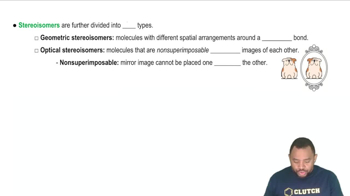
Stereoisomerism

Stereoisomerism refers to the phenomenon where compounds have the same molecular formula and connectivity of atoms but differ in the spatial arrangement of their atoms. This can lead to different physical and chemical properties. The two main types of stereoisomerism are geometric (cis-trans) and optical isomerism, which involves chiral centers.
추천 영상:

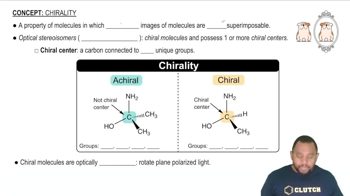
Chirality

Chirality is a property of a molecule that makes it non-superimposable on its mirror image, much like left and right hands. A chiral molecule typically has one or more chiral centers, usually carbon atoms bonded to four different substituents. The presence of chirality in a compound can lead to the existence of enantiomers, which are pairs of stereoisomers that are mirror images of each other.
추천 영상:

Structural Representation

Structural representation involves depicting the arrangement of atoms within a molecule, which is crucial for understanding its stereochemistry. Common methods include Lewis structures, condensed formulas, and skeletal structures. For compounds exhibiting stereoisomerism, it is important to accurately represent the 3D orientation of substituents to distinguish between different isomers.
추천 영상:
가이드 코스
01:42
Resonance Structures