Ch.21 - Organic Chemistry
Tro - Chemistry: A Molecular Approach 4th Edition
Tro4th EditionChemistry: A Molecular ApproachISBN: 9780134112831당신이 사용하는 게 아니라요?교과서 변경
21장, 문제 58d

What are the products of each alkene addition reaction? d.

검증된 단계별 안내
1
Identify the type of alkene addition reaction being asked about. Common types include hydrogenation, halogenation, hydrohalogenation, and hydration.
Determine the structure of the alkene involved in the reaction. Alkenes are hydrocarbons with at least one carbon-carbon double bond (C=C).
For each type of addition reaction, identify the reagents and conditions required. For example, hydrogenation requires H2 and a metal catalyst, while halogenation involves a halogen like Br2 or Cl2.
Predict the product by adding the elements of the reagent across the double bond of the alkene. For example, in halogenation, each carbon of the double bond will bond with one halogen atom.
Consider any regioselectivity or stereoselectivity that might affect the product. For example, in hydrohalogenation, Markovnikov's rule often applies, where the hydrogen atom bonds to the carbon with more hydrogen atoms already attached.

비슷한 문제에 대한 검증된 영상 답변:

이 영상 해법은 위 문제에 도움이 된다고 튜터들이 추천한 것입니다.
영상 길이:
1m

주요 개념

질문에 올바르게 답하기 위해 반드시 이해해야 하는 핵심 개념들은 다음과 같습니다.

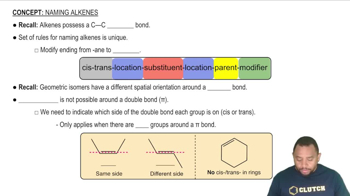
Alkene Structure

Alkenes are hydrocarbons that contain at least one carbon-carbon double bond (C=C). This unsaturation makes them more reactive than alkanes, allowing them to undergo various addition reactions. The geometry around the double bond is typically trigonal planar, which influences the orientation of the addition products.
추천 영상:
가이드 코스
02:47
Rules for Naming Alkenes

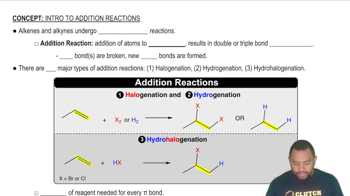
Addition Reactions

Addition reactions involve the addition of atoms or groups to the carbon atoms of the double bond in alkenes, resulting in the formation of saturated compounds. Common types of addition reactions include hydrogenation, halogenation, and hydrohalogenation, each producing different products based on the reagents used and the conditions of the reaction.
추천 영상:
가이드 코스
02:55
Addition Reactions

Markovnikov's Rule

Markovnikov's Rule states that in the addition of HX (where X is a halogen) to an alkene, the hydrogen atom will attach to the carbon with the greater number of hydrogen atoms already attached. This rule helps predict the major product of the reaction, as it favors the formation of the more stable carbocation intermediate during the reaction process.
추천 영상:
가이드 코스
00:28
Solubility Rules