
교과서 질문
Calculate the empirical formula for each natural flavor based on its elemental mass percent composition. a. methyl butyrate (component of apple taste and smell): C 58.80%, H 9.87%, O 31.33%
1232
views

 검증된 단계별 안내
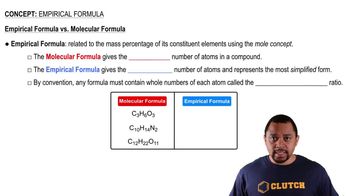
 02:26
02:26
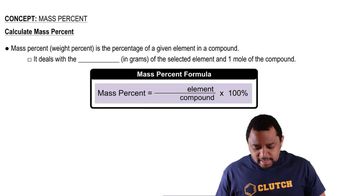 00:38
00:38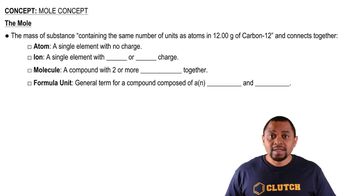 01:25
01:25Calculate the empirical formula for each natural flavor based on its elemental mass percent composition. a. methyl butyrate (component of apple taste and smell): C 58.80%, H 9.87%, O 31.33%
Calculate the empirical formula for each stimulant based on its elemental mass percent composition.
a. nicotine (found in tobacco leaves): C 74.03%, H 8.70%, N 17.27%
b. caffeine (found in coffee beans): C 49.48%, H 5.19%, N 28.85%, O 16.48%
The elemental mass percent composition of ascorbic acid (vitamin C) is 40.92% C, 4.58% H, and 54.50% O. Determine the empirical formula of ascorbic acid.
The elemental mass percent composition of ibuprofen (a nonsteroidal anti-inflammatory drug [NSAID]) is 75.69% C, 8.80% H, and 15.51% O. Determine the empirical formula of ibuprofen.
A chemist decomposes samples of several compounds; the masses of their constituent elements are listed. Calculate the empirical formula for each compound. c. 2.128 g Be, 7.557 g S, 15.107 g O