Ch.3 - Molecules, Compounds & Chemical Equations
Tro - Chemistry: A Molecular Approach 4th Edition
Tro4th EditionChemistry: A Molecular ApproachISBN: 9780134112831당신이 사용하는 게 아니라요?교과서 변경
3장, 문제 62

What is the mass of each sample? a. 15.7 mol HNO3 b. 1.04 × 10^-3 mol H2O2 c. 72.1 mmol SO2 d. 1.23 mol xenon difluoride

검증된 단계별 안내
1
insert step 1
insert step 2
insert step 3
insert step 4
insert step 5

주요 개념

질문에 올바르게 답하기 위해 반드시 이해해야 하는 핵심 개념들은 다음과 같습니다.

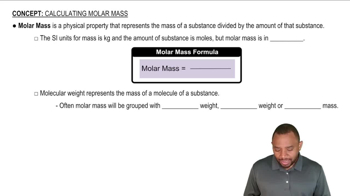
Molar Mass

Molar mass is the mass of one mole of a substance, typically expressed in grams per mole (g/mol). It is calculated by summing the atomic masses of all the atoms in a molecule. For example, the molar mass of HNO3 is approximately 63.01 g/mol, which is essential for converting moles to grams.
추천 영상:
가이드 코스
02:11
Molar Mass Concept

Conversion Between Moles and Mass

To find the mass of a substance from its amount in moles, the formula used is: mass (g) = moles × molar mass (g/mol). This relationship allows chemists to convert between the number of moles of a substance and its corresponding mass, facilitating calculations in stoichiometry and chemical reactions.
추천 영상:
가이드 코스
02:28
Mass and Moles Conversion

Unit Conversions

Unit conversions are necessary when dealing with different units of measurement, such as converting millimoles (mmol) to moles (mol). Since 1 mmol is equal to 0.001 mol, understanding these conversions is crucial for accurately calculating the mass of substances in various units, ensuring consistency in chemical calculations.
추천 영상:
가이드 코스
01:56
Conversion Factors