Ch.3 - Molecules, Compounds & Chemical Equations
Tro - Chemistry: A Molecular Approach 4th Edition
Tro4th EditionChemistry: A Molecular ApproachISBN: 9780134112831당신이 사용하는 게 아니라요?교과서 변경
3장, 문제 23

Determine the number of each type of atom in each formula. a. Mg3(PO4)2 b. BaCl2 c. Fe(NO2)2 d. Ca(OH)2

검증된 단계별 안내
1
Identify the subscript numbers in each chemical formula, which indicate the number of atoms of each element present.
For compound a, Mg_3(PO_4)_2: Note that the subscript outside the parentheses multiplies the number of each atom inside the parentheses. Calculate the number of Mg, P, and O atoms.
For compound b, BaCl_2: The subscript directly after Cl indicates the number of Cl atoms. Determine the number of Ba and Cl atoms.
For compound c, Fe(NO_2)_2: The subscript outside the parentheses affects the number of N and O atoms inside. Calculate the number of Fe, N, and O atoms.
For compound d, Ca(OH)_2: The subscript outside the parentheses affects the number of O and H atoms inside. Determine the number of Ca, O, and H atoms.

비슷한 문제에 대한 검증된 영상 답변:

이 영상 해법은 위 문제에 도움이 된다고 튜터들이 추천한 것입니다.
영상 길이:
1m

주요 개념

질문에 올바르게 답하기 위해 반드시 이해해야 하는 핵심 개념들은 다음과 같습니다.

Chemical Formula Interpretation

A chemical formula represents the types and numbers of atoms in a compound. Subscripts indicate the number of atoms of each element present in the molecule. For example, in Mg3(PO4)2, the '3' indicates three magnesium atoms, while '(PO4)2' indicates two phosphate groups, each containing one phosphorus and four oxygen atoms.
추천 영상:
가이드 코스
03:13
Intepreting the Band of Stability

Parentheses in Chemical Formulas

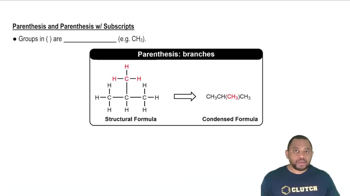
Parentheses in chemical formulas are used to group atoms that are part of a polyatomic ion or a molecular unit. The subscript outside the parentheses applies to all atoms within the parentheses. For instance, in Ca(OH)2, the '2' means there are two hydroxide ions (OH) for each calcium atom, resulting in two oxygen and two hydrogen atoms.
추천 영상:
가이드 코스
01:35
Parenthesis and Parenthesis w/ Subscripts

Counting Atoms in Compounds

To determine the total number of each type of atom in a compound, one must carefully account for both the subscripts and any coefficients. This involves multiplying the subscripts by any coefficients and summing the contributions from all parts of the formula. For example, in BaCl2, there is one barium atom and two chlorine atoms, leading to a total count of three atoms.
추천 영상: