

Ch.3 - Molecules, Compounds & Chemical Equations
Tro - Chemistry: A Molecular Approach 4th Edition
Tro4th EditionChemistry: A Molecular ApproachISBN: 9780134112831당신이 사용하는 게 아니라요?교과서 변경
3장, 문제 133

Epsom salts is a hydrated ionic compound with the following formula: MgSO4 • x H2O. A 4.93-g sample of Epsom salts is heated to drive off the water of hydration. The mass of the sample after complete dehydration is 2.41 g. Find the number of waters of hydration (x) in Epsom salts.

검증된 단계별 안내
1
Step 1: Calculate the mass of the water driven off during the heating process. This can be done by subtracting the mass of the dehydrated sample from the original mass of the sample.
Step 2: Convert the mass of the water and the dehydrated sample (MgSO4) to moles. The molar mass of water (H2O) is approximately 18.015 g/mol and the molar mass of MgSO4 is approximately 120.37 g/mol.
Step 3: Divide the number of moles of water by the number of moles of MgSO4. This will give you the ratio of moles of water to moles of MgSO4, which is the value of x in the formula MgSO4 # x H2O.
Step 4: If the ratio is not a whole number, it may need to be rounded to the nearest whole number, as the number of waters of hydration (x) in a compound is typically a whole number.
Step 5: The value of x obtained is the number of waters of hydration in Epsom salts.

비슷한 문제에 대한 검증된 영상 답변:

이 영상 해법은 위 문제에 도움이 된다고 튜터들이 추천한 것입니다.
도움이 되었나요?

주요 개념

질문에 올바르게 답하기 위해 반드시 이해해야 하는 핵심 개념들은 다음과 같습니다.

Hydrated Ionic Compounds

Hydrated ionic compounds, like Epsom salts (MgSO4·xH2O), consist of ionic species combined with water molecules. The 'x' in the formula represents the number of water molecules associated with each formula unit of the ionic compound. Understanding this concept is crucial for determining the amount of water lost during dehydration and calculating the value of 'x'.
추천 영상:
가이드 코스
02:04
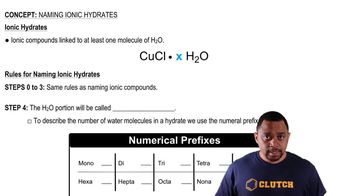
Ionic Hydrates Naming

Mass Loss and Stoichiometry

Stoichiometry involves the quantitative relationships between reactants and products in a chemical reaction. In this case, the mass loss during the heating of Epsom salts indicates the amount of water that was present. By applying stoichiometric principles, one can relate the initial mass of the hydrated compound to the mass of the dehydrated compound to find the number of water molecules.
추천 영상:
가이드 코스
01:16
Stoichiometry Concept

Molar Mass Calculation

Calculating molar mass is essential for converting between grams and moles of a substance. To find 'x', one must first determine the molar mass of both the hydrated and dehydrated forms of Epsom salts. This calculation allows for the determination of the number of moles of water lost, which directly correlates to the value of 'x' in the hydrated formula.
추천 영상:
가이드 코스
03:12
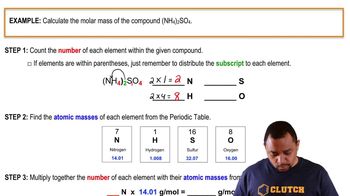
Molar Mass Calculation Example
관련 실천
교과서 질문

A hydrate of copper(II) chloride has the following formula: CuCl2 • x H2O. The water in a 3.41-g sample of the hydrate is driven off by heating. The remaining sample has a mass of 2.69 g. Find the number of waters of hydration (x) in the hydrate.

3683
views
교과서 질문

A compound of molar mass 177 g/mol contains only carbon, hydrogen, bromine, and oxygen. Analysis reveals that the compound contains eight times as much carbon as hydrogen by mass. Find the molecular formula.

1765
views
교과서 질문

Combustion analysis of a 13.42-g sample of equilin (which contains only carbon, hydrogen, and oxygen) produces 39.61 g CO2 and 9.01 g H2O. The molar mass of equilin is 268.34 g/mol. Find its molecular formula.

3137
views
교과서 질문

Fructose is a common sugar found in fruit. Elemental analysis of fructose gives the following mass percent composition: C 40.00%, H 6.72%, O 53.28%. The molar mass of fructose is 180.16 g/mol. Find the molecular formula of fructose.

2020
views
교과서 질문

Estrone, which contains only carbon, hydrogen, and oxygen, is a female sexual hormone in the urine of pregnant women. Combustion analysis of a 1.893-g sample of estrone produces 5.545 g of CO2 and 1.388 g H2O. The molar mass of estrone is 270.36 g/mol. Find its molecular formula.

1481
views
1
rank
교과서 질문

Researchers obtained the following data from experiments to find the molecular formula of benzocaine, a local anesthetic, which contains only carbon, hydrogen, nitrogen, and oxygen. Complete combustion of a 3.54-g sample of benzocaine with excess O2 forms 8.49 g of CO2 and 2.14 g H2O. Another 2.35-g sample contains 0.199 g of N. The molar mass of benzocaine is 165 g/mol. Find the molar formula of benzocaine.

1229
views
1
rank