

Ch.4 - Chemical Quantities & Aqueous Reactions
Tro - Chemistry: A Molecular Approach 4th Edition
Tro4th EditionChemistry: A Molecular ApproachISBN: 9780134112831당신이 사용하는 게 아니라요?교과서 변경
4장, 문제 108

The combustion of liquid ethanol (C2H5OH) produces carbon dioxide and water. After 4.62 mL of ethanol (density = 0.789 g/mL) is allowed to burn in the presence of 15.55 g of oxygen gas, 3.72 mL of water (density = 1.00 g/mL) is collected. Determine the percent yield for the reaction. (Hint: Write a balanced equation for the combustion of ethanol.)

검증된 단계별 안내
1
Step 1: Write the balanced chemical equation for the combustion of ethanol. The balanced equation is: C2H5OH + 3O2 → 2CO2 + 3H2O.
Step 2: Convert the volume of ethanol to mass using its density. The formula to use is mass = volume x density. In this case, the volume of ethanol is 4.62 mL and the density is 0.789 g/mL.
Step 3: Convert the mass of ethanol to moles using its molar mass. The molar mass of ethanol is approximately 46.07 g/mol.
Step 4: Determine the theoretical yield of water. According to the balanced equation, 3 moles of water are produced for every mole of ethanol. So, multiply the moles of ethanol by 3 to get the theoretical yield of water in moles. Then, convert this to grams using the molar mass of water (18.015 g/mol).
Step 5: Convert the volume of water collected to mass using its density (1.00 g/mL), then calculate the percent yield using the formula: percent yield = (actual yield / theoretical yield) x 100%. The actual yield is the mass of water collected, and the theoretical yield was calculated in the previous step.

비슷한 문제에 대한 검증된 영상 답변:

이 영상 해법은 위 문제에 도움이 된다고 튜터들이 추천한 것입니다.

주요 개념

질문에 올바르게 답하기 위해 반드시 이해해야 하는 핵심 개념들은 다음과 같습니다.

Combustion Reaction

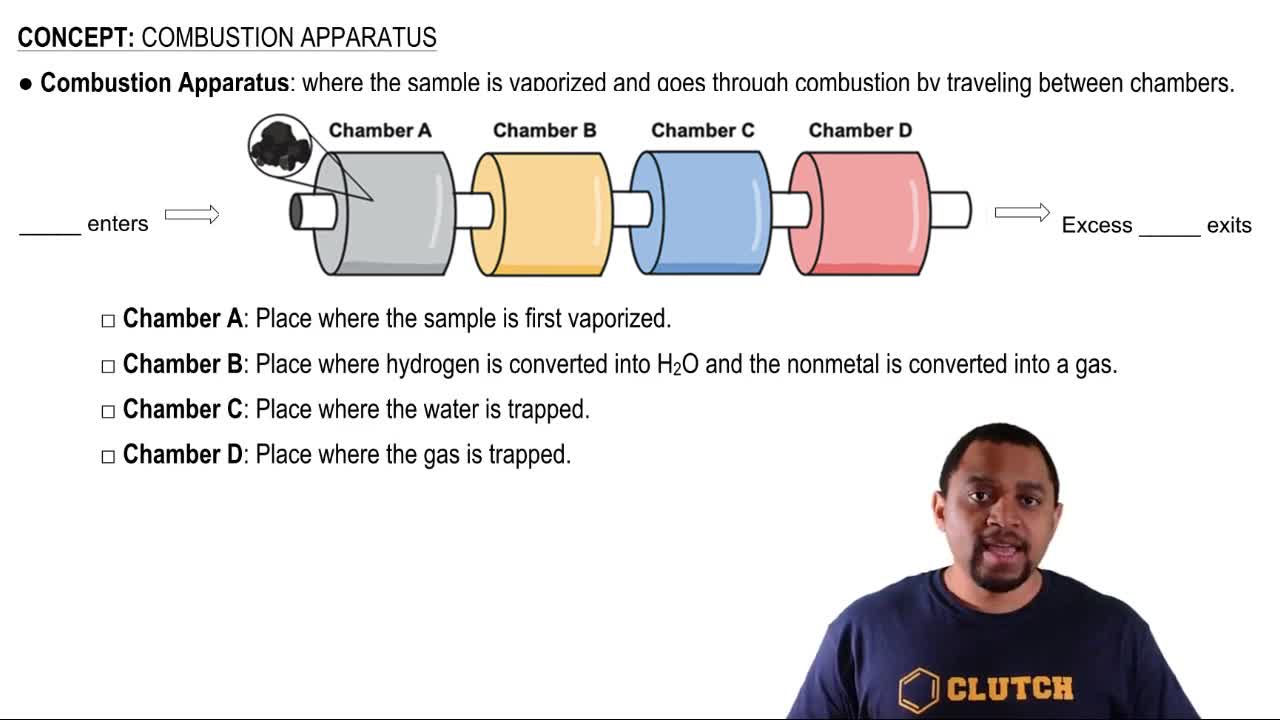
A combustion reaction is a chemical process in which a substance reacts rapidly with oxygen, producing heat and light. In the case of ethanol, the balanced equation for its combustion is C2H5OH + 3O2 → 2CO2 + 3H2O. Understanding this reaction is crucial for determining the stoichiometry involved and the theoretical yield of products.
추천 영상:
가이드 코스
02:24
Combustion Apparatus

Stoichiometry

Stoichiometry involves the calculation of reactants and products in chemical reactions based on the balanced equation. It allows us to determine how much of each substance is consumed or produced. In this question, stoichiometry is essential for calculating the theoretical yield of water produced from the combustion of ethanol, which is then compared to the actual yield to find the percent yield.
추천 영상:
가이드 코스
01:16
Stoichiometry Concept

Percent Yield

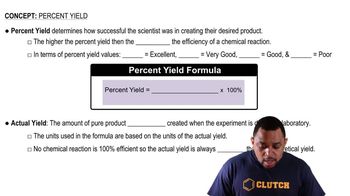
Percent yield is a measure of the efficiency of a chemical reaction, calculated by comparing the actual yield of a product to the theoretical yield. It is expressed as a percentage using the formula: (actual yield / theoretical yield) × 100%. In this scenario, calculating the percent yield of water produced from the combustion of ethanol will provide insight into the reaction's efficiency.
추천 영상:
가이드 코스
03:09
Percent Yield in Reactions
관련 실천
교과서 질문

A hydrochloric acid solution will neutralize a sodium hydroxide solution. Look at the molecular views showing one beaker of HCl and four beakers of NaOH. Which NaOH beaker will just neutralize the HCl beaker? Begin by writing a balanced chemical equation for the neutralization reaction.

1954
views
교과서 질문

The combustion of gasoline produces carbon dioxide and water. Assume gasoline to be pure octane (C8H18) and calculate the mass (in kg) of carbon dioxide that is added to the atmosphere per 1.0 kg of octane burned. (Hint: Begin by writing a balanced equation for the combustion reaction.)

8545
views
교과서 질문

Many home barbeques are fueled with propane gas (C3H8). What mass of carbon dioxide (in kg) is produced upon the complete combustion of 18.9 L of propane (approximate contents of one 5-gallon tank)? Assume that the density of the liquid propane in the tank is 0.621 g/mL. (Hint: Begin by writing a balanced equation for the combustion reaction.)

1581
views
교과서 질문

Predict the products and write a balanced molecular equation for each reaction. If no reaction occurs, write 'NO REACTION.' a. HCl(aq) + Hg2(NO3)2(aq) →

673
views
교과서 질문

Aspirin can be made in the laboratory by reacting acetic anhydride (C4H6O3) with salicylic acid (C7H6O3) to form aspirin (C9H8O4) and acetic acid (C2H4O2). The balanced equation is: C4H6O3 + C7H6O3 → C9H8O4 + C2H4O2 In a laboratory synthesis, a student begins with 3.00 mL of acetic anhydride (density = 1.08 g/mL) and 1.25 g of salicylic acid. Once the reaction is complete, the student collects 1.22 g of aspirin. Determine the limiting reactant. Determine the theoretical yield of aspirin. Determine the percent yield for the reaction.

17660
views