Ch.4 - Chemical Quantities & Aqueous Reactions
Tro - Chemistry: A Molecular Approach 4th Edition
Tro4th EditionChemistry: A Molecular ApproachISBN: 9780134112831당신이 사용하는 게 아니라요?교과서 변경
4장, 문제 75

Complete and balance the following equation. If no reaction occurs, write “NO REACTION.” NaOH(aq) + FeCl3(aq) → ?

검증된 단계별 안내
1
Identify the reactants: NaOH (sodium hydroxide) and FeCl3 (iron(III) chloride).
Determine the possible products: NaCl (sodium chloride) and Fe(OH)3 (iron(III) hydroxide).
Write the unbalanced equation: NaOH(aq) + FeCl3(aq) → NaCl(aq) + Fe(OH)3(s).
Balance the equation by adjusting coefficients: Start by balancing the Fe atoms, then the Cl atoms, and finally the Na and OH groups.
Check the balanced equation to ensure mass and charge are conserved.

주요 개념

질문에 올바르게 답하기 위해 반드시 이해해야 하는 핵심 개념들은 다음과 같습니다.

Double Displacement Reaction

A double displacement reaction, also known as a metathesis reaction, occurs when two compounds exchange ions to form two new compounds. In this case, NaOH and FeCl3 can potentially react to form NaCl and Fe(OH)3. Understanding this type of reaction is crucial for predicting the products of the given equation.
추천 영상:
가이드 코스
01:11
Single Displacement Reactions

Solubility Rules

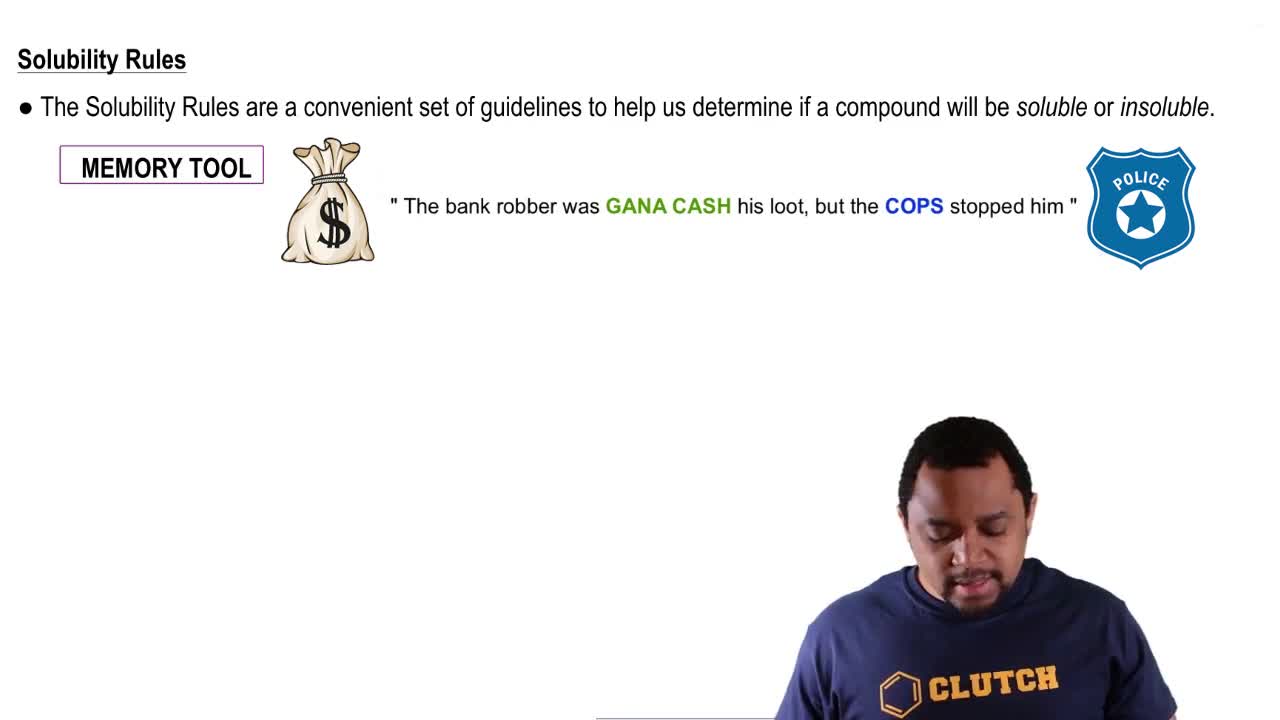
Solubility rules help determine whether a compound will dissolve in water or precipitate out as a solid. For instance, while NaCl is soluble in water, Fe(OH)3 is generally insoluble. Knowing these rules is essential for predicting whether a reaction will occur and if a precipitate will form.
추천 영상:
가이드 코스
00:28
Solubility Rules

Balancing Chemical Equations

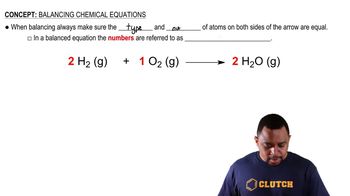
Balancing chemical equations involves ensuring that the number of atoms for each element is the same on both sides of the equation. This is based on the law of conservation of mass, which states that matter cannot be created or destroyed in a chemical reaction. Proper balancing is necessary to accurately represent the reaction and its products.
추천 영상:
가이드 코스
01:32
Balancing Chemical Equations