
Ch.4 - Chemical Quantities & Aqueous Reactions
Tro - Chemistry: A Molecular Approach 4th Edition
Tro4th EditionChemistry: A Molecular ApproachISBN: 9780134112831당신이 사용하는 게 아니라요?교과서 변경
4장, 문제 3

Consider the balanced equation: 2 N2H4(g) + N2O4(g) → 3 N2(g) + 4 H2O(g). Complete the table showing the appropriate number of moles of reactants and products. If the number of moles of a reactant is provided, fill in the required amount of the other reactant, as well as the moles of each product that forms. If the number of moles of a product is provided, fill in the required amount of each reactant to make that amount of product, as well as the amount of the other product that forms. Mol N2H4 Mol N2O4 Mol N2 Mol H2O 2 _____ _____ _____ _____ 5 _____ _____ _____ _____ _____ 10 _____ _____ 11.8 _____ 2.5 _____ _____ _____ _____ 4.2 _____ _____

검증된 단계별 안내
1
Identify the stoichiometric coefficients from the balanced equation: 2 N2H4(g) + 1 N2O4(g) → 3 N2(g) + 4 H2O(g).
Use the stoichiometric coefficients to set up mole ratios for each reactant and product. For example, the mole ratio of N2H4 to N2 is 2:3, and the mole ratio of N2O4 to H2O is 1:4.
For each row in the table, use the given number of moles to calculate the unknowns using the mole ratios. For instance, if 2 moles of N2H4 are given, calculate the moles of N2O4 needed and the moles of N2 and H2O produced.
If the number of moles of a product is given, use the inverse of the mole ratios to find the required moles of reactants. For example, if 11.8 moles of N2 are produced, calculate the moles of N2H4 and N2O4 required.
Repeat the process for each row, ensuring that the stoichiometric relationships are maintained throughout the calculations.

주요 개념

질문에 올바르게 답하기 위해 반드시 이해해야 하는 핵심 개념들은 다음과 같습니다.

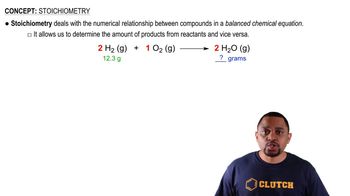
Stoichiometry

Stoichiometry is the branch of chemistry that deals with the quantitative relationships between reactants and products in a chemical reaction. It is based on the conservation of mass and the mole concept, allowing chemists to predict how much of each substance is needed or produced in a reaction. In the given equation, stoichiometric coefficients indicate the ratio of moles of each substance involved, which is essential for completing the table.
추천 영상:
가이드 코스
01:16
Stoichiometry Concept

Mole Ratio

The mole ratio is derived from the coefficients of a balanced chemical equation and represents the proportion of moles of one substance to another. For example, in the equation provided, the mole ratio of N2H4 to N2O4 is 2:1, meaning that two moles of hydrazine react with one mole of dinitrogen tetroxide. Understanding these ratios is crucial for calculating the amounts of reactants and products in the reaction.
추천 영상:
가이드 코스
02:14
Neutron-Proton Ratio

Limiting Reactant

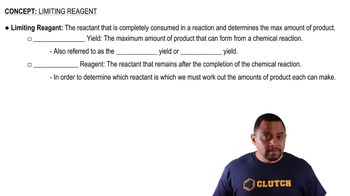
The limiting reactant is the substance that is completely consumed first in a chemical reaction, thus determining the maximum amount of product that can be formed. Identifying the limiting reactant is essential for accurate stoichiometric calculations, as it affects the amounts of other reactants and products. In the context of the question, knowing which reactant is limiting will help in filling out the table correctly based on the provided moles.
추천 영상:
가이드 코스
01:30
Limiting Reagent Concept