What is the molarity of ZnCl2 that forms when 25.0 g of zinc completely reacts with CuCl2 according to the following reaction? Assume a final volume of 275 mL. Zn(s) + CuCl2(aq) → ZnCl2(aq) + Cu(s)
Ch.4 - Chemical Quantities & Aqueous Reactions
4장, 문제 65
Consider the precipitation reaction: 2 Na3PO4(aq) + 3 CuCl2(aq) → Cu3(PO4)2(s) + 6 NaCl(aq). What volume of 0.175 M Na3PO4 solution is necessary to completely react with 95.4 mL of 0.102 M CuCl2?
검증된 단계별 안내1
Identify the balanced chemical equation: \(2 \text{Na}_3\text{PO}_4(aq) + 3 \text{CuCl}_2(aq) \rightarrow \text{Cu}_3(\text{PO}_4)_2(s) + 6 \text{NaCl}(aq)\).
Determine the moles of \(\text{CuCl}_2\) using its concentration and volume: \(\text{moles of } \text{CuCl}_2 = 0.102 \text{ M} \times 0.0954 \text{ L}\).
Use the stoichiometry of the reaction to find the moles of \(\text{Na}_3\text{PO}_4\) needed. According to the balanced equation, 2 moles of \(\text{Na}_3\text{PO}_4\) react with 3 moles of \(\text{CuCl}_2\).
Calculate the moles of \(\text{Na}_3\text{PO}_4\) required using the ratio from the balanced equation: \(\text{moles of } \text{Na}_3\text{PO}_4 = \frac{2}{3} \times \text{moles of } \text{CuCl}_2\).
Determine the volume of \(0.175 \text{ M } \text{Na}_3\text{PO}_4\) solution needed using its concentration: \(\text{Volume} = \frac{\text{moles of } \text{Na}_3\text{PO}_4}{0.175 \text{ M}}\).
주요 개념
질문에 올바르게 답하기 위해 반드시 이해해야 하는 핵심 개념들은 다음과 같습니다.
Stoichiometry
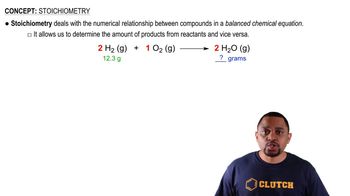
Stoichiometry is the calculation of reactants and products in chemical reactions based on the balanced chemical equation. It allows us to determine the proportions of substances involved in a reaction, which is essential for solving problems related to the amounts of reactants needed or products formed.
추천 영상:
가이드 코스
Stoichiometry Concept
Molarity
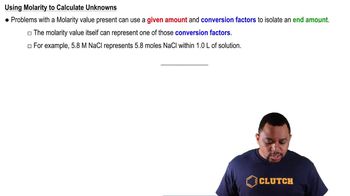
Molarity is a measure of concentration defined as the number of moles of solute per liter of solution. It is expressed in moles per liter (M) and is crucial for converting between volume and amount of substance in chemical reactions, enabling us to calculate how much of a solution is required to react with a given amount of another substance.
추천 영상:
가이드 코스
Molarity
Precipitation Reactions
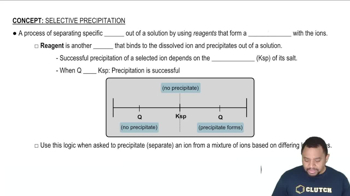
Precipitation reactions occur when two aqueous solutions react to form an insoluble solid, known as a precipitate. Understanding these reactions is important for predicting the formation of solids in solution and for calculating the amounts of reactants needed to achieve complete precipitation, as seen in the given reaction.
추천 영상:
가이드 코스
Selective Precipitation
관련 실천
교과서 질문
2834
views
1
rank
교과서 질문
If 123 mL of a 1.1 M glucose solution is diluted to 500.0 mL, what is the molarity of the diluted solution?
1850
views
교과서 질문
To what volume should you dilute 50.0 mL of a 12 M stock HNO3 solution to obtain a 0.100 M HNO3 solution?
1716
views
교과서 질문
If 3.5 L of a 4.8 M SrCl2 solution is diluted to 45 L, what is the molarity of the diluted solution?
1131
views
교과서 질문
What is the minimum amount of 6.0 M H2SO4 necessary to produce 25.0 g of H2(g) according to the reaction between aluminum and sulfuric acid? 2 Al(s) + 3 H2SO4(aq) → Al2(SO4)3(aq) + 3 H2(g)
5198
views
4
rank
교과서 질문
Consider the reaction: Li2S(aq) + Co(NO3)2(aq) → 2 LiNO3(aq) + CoS(s) What volume of 0.150 M Li2S solution is required to completely react with 125 mL of 0.150 M Co(NO3)2?
2484
views