
Ch.4 - Chemical Quantities & Aqueous Reactions
Tro - Chemistry: A Molecular Approach 4th Edition
Tro4th EditionChemistry: A Molecular ApproachISBN: 9780134112831당신이 사용하는 게 아니라요?교과서 변경
4장, 문제 33

For each of the reactions, calculate the mass (in grams) of the product that forms when 3.67 g of the underlined reactant completely reacts. Assume that there is more than enough of the other reactant. a. Ba(s) + Cl2(g) → BaCl2(s) b. CaO(s) + CO2(g) → CaCO3(s) c. 2 Mg(s) + O2(g) → 2 MgO(s) d. 4 Al(s) + 3 O2(g) → 2 Al2O3(s)

검증된 단계별 안내
1
Identify the underlined reactant in each reaction and note its molar mass.
Convert the mass of the underlined reactant (3.67 g) to moles using its molar mass: \( \text{moles} = \frac{\text{mass}}{\text{molar mass}} \).
Use the stoichiometry of the balanced chemical equation to determine the moles of product formed from the moles of the underlined reactant.
Calculate the molar mass of the product in each reaction.
Convert the moles of product to grams using its molar mass: \( \text{mass} = \text{moles} \times \text{molar mass} \).

주요 개념

질문에 올바르게 답하기 위해 반드시 이해해야 하는 핵심 개념들은 다음과 같습니다.

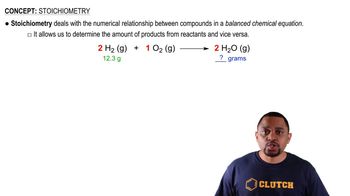
Stoichiometry

Stoichiometry is the branch of chemistry that deals with the quantitative relationships between the reactants and products in a chemical reaction. It allows chemists to predict the amounts of substances consumed and produced in a reaction based on balanced chemical equations. Understanding stoichiometry is essential for calculating the mass of products formed from a given mass of reactants.
추천 영상:
가이드 코스
01:16
Stoichiometry Concept

Molar Mass

Molar mass is the mass of one mole of a substance, typically expressed in grams per mole (g/mol). It is calculated by summing the atomic masses of all the atoms in a molecule. Knowing the molar mass of reactants and products is crucial for converting between grams and moles, which is necessary for stoichiometric calculations in chemical reactions.
추천 영상:
가이드 코스
02:11
Molar Mass Concept

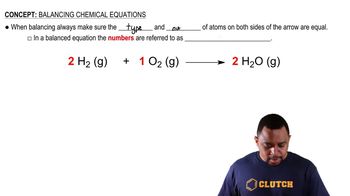
Balanced Chemical Equations

A balanced chemical equation represents a chemical reaction with equal numbers of each type of atom on both sides of the equation. Balancing ensures the law of conservation of mass is upheld, meaning that matter is neither created nor destroyed in a reaction. This is fundamental for stoichiometric calculations, as it provides the ratios needed to determine the amounts of reactants and products involved.
추천 영상:
가이드 코스
01:32
Balancing Chemical Equations